Pirates and Privateers Pirates and Privateers
The History of Maritime
Piracy
Cindy Vallar, Editor
& Reviewer
P.O. Box 425,
Keller, TX 76244-0425

Who Will Try the Case?
Law & Order: Pirate Edition (part 7)
by Cindy Vallar

(Source: Shutterstock)
Jurisdiction often
comes into play in cases of modern piracy, but every
once in a blue moon, it is an issue that had to be
dealt with in the past. One case that best
illustrates this involved Benito de Soto and Morning Star. He and
his men are particularly brutal pirates, as Nicholas
Fernandez confesses prior to his execution.
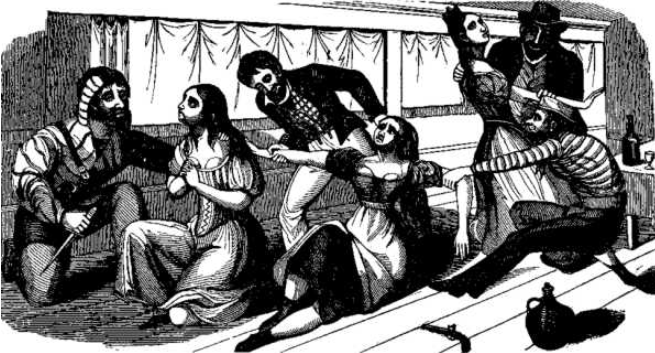
In February 1846, Fernandez participated in the
capture of a Portuguese ship carrying forty people,
some of whom were women and children.
[S]uspecting
our character, and if overpowered by us,
expecting no mercy, they bravely defended
themselves, and twice with no other weapons than
their knives, drove us from their decks, nor
were they finally overpowered until they had
killed three of our men, and severely wounded
six more – our chief, as well as most on board .
. . breathed nothing but revenge, and would not
. . . be satisfied with any thing short of the
total destruction of the lives of all on board,
without respect to sex or age! – a few light and
most valuable articles found on board were
thrown into our boats, and the ship then set on
fire in three or four different places in her
hold and cabin; and not until the flames had so
increased that it was judged impossible for the
wretched victims left on board to extinguish it,
had we permission to quit the ship – the fire in
columns bursting from every port, and
communicating to the sails and rigging, soon
drove the poor sufferers forward even to the
extreme end of the ship’s bowsprit – where, with
up-lifted hands they most earnestly intreated us
to spare their lives! as we had destroyed the
ship’s boats, all retreat was cut off, except to
plunge themselves into the sea, which many did,
but . . . all who approached the schooner . . .
were shot in the water and others killed with
hatchets while attempting to gain our decks! –
the shrieks and dying groans of the unhappy
victims on board the burning ship, as the
devouring flames approached them, were
calculated to pierce the hearts of any but
barbarians like ourselves, destitute of every
humane feeling – in less than one hour the
shrieks of the dying had ceased . . . and little
more was visible of the late noble ship but her
bottom, burnt to the water’s edge! (Dying,
11-12)
As horrible and
heartrending as his description, this was not the
piratical act that brought about his demise because
he and his fellow pirates left no witnesses. When
the ship failed to reach port, the owners and
authorities just assumed that she was lost at sea
and everyone on board perished. Two years passed
before another attack eventually brought about the
pirates’ downfall. This time, they chose an English
ship named Morning Star.
[O]n board
[were] forty or fifty souls, including seventeen
sick soldiers, and several women and children .
. . we proceeded to strip the ship of every
thing valuable that could be easily removed . .
. the men on board, including the sick soldiers,
were confined in the hold, and the wretched
females and the children being secured in the
cabin, we next proceeded to prepare our minds by
the free use of the liquor found therein, for
the commission of crimes . . . we proceeded to
commit such excesses as decency forbids that I
should mention! (Dying, 14-15)
Once the pirates finished their debauchery, they set
about destroying all evidence of their crimes.
. . . with
the women and children still confined to the
cabin, and the men (including the sick soldiers)
to the hold, without a possibility of their
being able to liberate themselves, the ship was
by us scuttled and abandoned, and soon after
sunk to the bottom with, every soul on board!
and to close the tragic scene, the captain and
four men whom we had retained on board the brig,
were next murdered and their bodies thrown into
the sea! (Dying, 16)
The slaying of all the
innocent lives was what the pirates thought
happened. In realty, the women were made of sterner
stuff. Even with the ship’s hatches sealed shut,
holes bored in Morning Star’s hull below the
waterline, masts toppled and rigging destroyed, and
she was afire, two women escaped the locked cabin
and released the men. With assistance from another
ship, Morning Star reached London.
Once the pirates were arrested in Cadiz, Spain,
where to hold the trial became an issue. England
certainly wanted to prosecute, since her citizens
had experienced the horrors of de Soto’s attack, and
Morning Star was an English ship, but trying
the culprits “was only feasible if it could be
proved in court that any of the arrested pirates had
‘actively participated’ in the plunder or murder of
persons aboard an English vessel in international
waters.” (Ford, 128) What the government found
troubling was not that the victims could testify
about the attack but that the very public trial
would bring to light issues the authorities
preferred to keep quiet. For example, Morning
Star was licensed by the East India Company (EIC) and
the Admiralty’s First Secretary, Sir John Croker, had ties to
the EIC and had ignored “countless warnings from
serving Royal Navy captains, the Secretary of
Lloyd’s and Members of Parliament about the
dangerous resurgence . . . of piracy in the
Atlantic.” (Ford, 129) In addition, Morning Star
became perfect prey because she had fallen behind
the rest of the convoy with which she’d been
travelling, and that convoy had been protected by
“well-armed East India Company ships while she was
carrying wounded soldiers, women and children – not
to mention British Prize Fund treasure.” (Ford, 129)
Such revelations would have fueled a media frenzy.
Another complicating factor was that Benito de Soto
had not been aboard Morning Star, and
therefore, no witness could directly testify that
the pirate captain was a participant. For these
reasons, Great Britain decided Spain should
prosecute.
Technically, the United States could also claim
jurisdiction. The pirates, prior to their capture,
had attacked Topaz, an American ship, and
some of the plundered cargo had been found in the
pirates’ possession. There were no witnesses to what
befell Topaz because the Boston ship had
gone missing. (The common belief was that she had
been lost to pirates.) When the United States failed
to come forward, jurisdiction defaulted to Spain
where the pirates were imprisoned.
 A
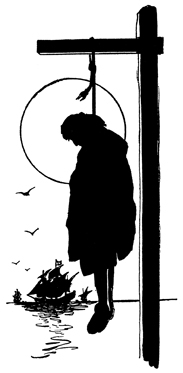
military court tried twelve pirates in November
1829. Joaquim Palabra, a young servant on the pirate
ship, was declared not guilty. Five were “condemned
to the galleys – one for ten, one for
eight, and three for six years.” (Ford, 201) Six
pirates were sentenced to be hanged and quartered,
and their heads displayed at coastal forts. A
military court tried twelve pirates in November
1829. Joaquim Palabra, a young servant on the pirate
ship, was declared not guilty. Five were “condemned
to the galleys – one for ten, one for
eight, and three for six years.” (Ford, 201) Six
pirates were sentenced to be hanged and quartered,
and their heads displayed at coastal forts.
The only pirate whom the British did try was Benito
de Soto but not in England. His trial opened in
January 1830, at Gibraltar, even though one jurist
had previously said, “the Crown had no provable
case.” (Ford, 205) The main stumbling block
continued to be the fact that no one could identify
de Soto as one of the perpetrators, and Spain
refused to allow any of the galley slaves to
testify. Equally troubling was that he no longer
looked like the fiendish pirate who had attacked Morning
Star. Even so, the prosecutor said a steward
will go so
far as to swear to the figure, gait, and general
appearance of the prisoner, although he could
not swear to his features. As the two vessels
were close to each other, he had an opportunity
of observing him; but because the prisoner was
holding a speaking-trumpet before his face . . .
the steward was unable to see his countenance.
(Ford, 2007)
This statement was a
direct contradiction to what the steward had said
long before the trial occurred. When he testified in
response to the prosecutor’s question, “‘Could you
recognize again the man holding the
speaking-trumpet?’”, the steward replied,
He stood
conspicuous enough for me to discern his
attitude and stature . . . but I never saw him
afterwards until I saw the prisoner in this
Court today. I do not hesitate a moment to say
he is the man who hailed us and gave directions
to his crew who came aboard Morning Star.
(Ford, 2009)
De Soto was furious. He
demanded to know how the man could possibly identify
him now when he couldn’t before. The steward’s
answer was “‘I can swear not from your face, but
from your height.’” (Ford, 2009) More than a few
people questioned the veracity of this testimony,
but the prosecutor announced that Spain would permit
Joaquim Palabra to come testify. When the lad saw de
Soto in the dock, he became unintelligible and the
court judged him to be unfit to testify. The
prosecution rested, and de Soto took the stand in
his own defense. He claimed to have no hand in the
robberies; he was simply a crew member on the pirate
ship. Even so, within minutes of being released to
consider the guilt or innocence of the accused, the
jury convicted de Soto of piracy and he was
sentenced to hang on the morning of 25 January 1830.
In the scheme of things, not much has changed as
regards jurisdiction and bringing pirates to justice
over the centuries. There are often more roadblocks
than one expects. At the beginning of 2009, the Combined Task Force 151 (CTF
151) was comprised of naval ships from multiple
countries and one of their primary objectives was to
counteract piracy in international waters around the
Horn of Africa. When first formed, a number of legal
issues arose. Some participant nations hadn’t yet
enacted laws against piracy.
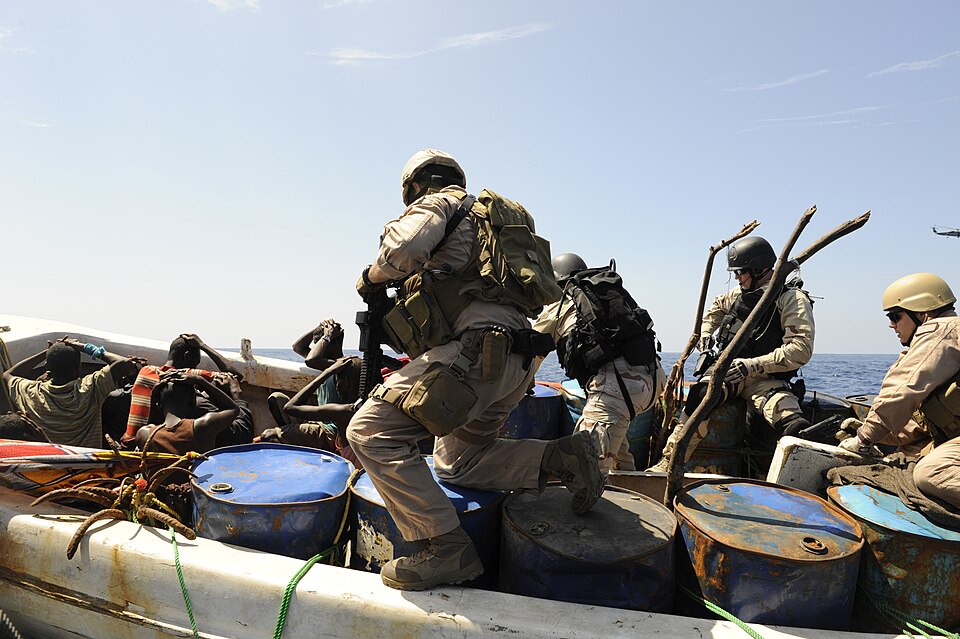
U.S. Coast Guard Law
Enforcement Detachment and Combined Task Force
team members from guided
missile destroyer USS Farragut board,
search, and seize a suspicious dhow in the
Indian Ocean in March 2010.
U.S. Navy Photo by Mass Communication
Specialist 1st Class Cassandra
Thompson/Released
(Source: Wikimedia Commons)
As Commander Pete Koebler of CTF 151 explained,
It is not
enough to say that international law allows for
universal jurisdiction over piracy. In order to
legally prosecute suspected pirates under a
nation’s own domestic laws, the nation concerned
must normally also have adopted some sort of
domestic criminal law concerning the topic of
piracy.
Even assuming a
particular nation does have a domestic law on
point, such a nation may well be concerned about
the precedent it will set whenever it elects to
prosecute a particular set of suspected pirates.
Having done so in an individual case, will they
now be honor bound by the court of popular
opinion to prosecute all similarly situated
suspected pirates in the future? Even if it will
not break the national treasury to prosecute a
particular set of suspected pirates, can the
nation afford to prosecute the numerous other
similar groups of suspected pirates who may well
be captured later that very same year?
(McKnight, 90-91)
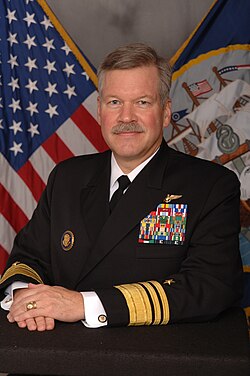 Of
the original participants only Denmark, the United
States, and the United Kingdom could legally arrest
suspected pirates. Three years later, seventy-one
pirates were in custody awaiting a decision as to
what to do with them. Vice Admiral Mark I. Fox,
commander of the United States Fifth Fleet, said in
an interview with a New York Times reporter
that “There is not a repeatable international
process to bring them to justice. We lack a
practical and reliable legal finish.” (McKnight, 87)
Victims, however, don’t care about jurisdictional
and legal issues. Mahmed Younes, captain of an
Iranian fishing dhow captured by pirates and rescued
by sailors from USS Kidd in 2012, had this to say: Of
the original participants only Denmark, the United
States, and the United Kingdom could legally arrest
suspected pirates. Three years later, seventy-one
pirates were in custody awaiting a decision as to
what to do with them. Vice Admiral Mark I. Fox,
commander of the United States Fifth Fleet, said in
an interview with a New York Times reporter
that “There is not a repeatable international
process to bring them to justice. We lack a
practical and reliable legal finish.” (McKnight, 87)
Victims, however, don’t care about jurisdictional
and legal issues. Mahmed Younes, captain of an
Iranian fishing dhow captured by pirates and rescued
by sailors from USS Kidd in 2012, had this to say:
The
punishment should be for the crime. They should
be taken to court and tried. At any cost they
should not be let go, because if you let them go
they will come back stronger and harass more
people. Every time these navies’ countries let
them go, the pirates just laugh at that. (McKnight,
89)
On rare occasions,
pirates are brought to justice. In this case, the
Seychelles agreed to prosecute. The pirates were
charged with three different counts, of which all
were found guilty. The adults were sentenced to
terms of twelve, eighteen, and eighteen years for
the three counts, and these would be served
concurrently. Two convicted pirates were minors and
sentenced to three, four, and four years for the
three counts. These sentences would be served at the
same time but in different facilities from the
adults.
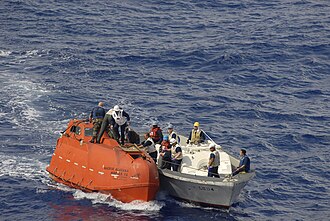 The attack on MV Maersk Alabama
is another example that resulted in prosecution. In
April 2009, the cargo ship was situated hundreds of
kilometers off Somalia’s coast on her way to
Mombasa, Kenya, when two pirates with AK-47s boarded
her. Captain Richard Phillips and two other
Americans were on the bridge at the time; the
remainder of the crew locked themselves in a
fortified safe room where they could still control
the vessel’s movements. Two additional pirates
joined their comrades, and a search began for the
missing crewmen. The Alabamians ambushed and
captured a pirate; he would be returned to the
pirates if they released Captain Phillips. An
agreement was reached and the crew released their
captive, but the pirates reneged and forced Captain Phillips to board the
cargo ship’s lifeboat. To release him, the pirates
demanded a ransom of $2,000,000. The attack on MV Maersk Alabama
is another example that resulted in prosecution. In
April 2009, the cargo ship was situated hundreds of
kilometers off Somalia’s coast on her way to
Mombasa, Kenya, when two pirates with AK-47s boarded
her. Captain Richard Phillips and two other
Americans were on the bridge at the time; the
remainder of the crew locked themselves in a
fortified safe room where they could still control
the vessel’s movements. Two additional pirates
joined their comrades, and a search began for the
missing crewmen. The Alabamians ambushed and
captured a pirate; he would be returned to the
pirates if they released Captain Phillips. An
agreement was reached and the crew released their
captive, but the pirates reneged and forced Captain Phillips to board the
cargo ship’s lifeboat. To release him, the pirates
demanded a ransom of $2,000,000.
USS Bainbridge, alerted to the impending
pirate attack by one of the Alabamians, arrived on
the scene, while a Navy SEAL team left Virginia to
help with the rescue. Abduwali Abdukhadir Musé, the
pirate tasked with assisting with ransom
negotiations, came aboard the warship. While there,
one of his comrades pointed his weapon at Captain
Phillips. Seeing that he was in imminent danger,
SEAL snipers received permission to take out the
three remaining pirates. Musé was taken into custody
and eventually transported to the United States to
stand trial, the first prosecution of a pirate on
American soil since 1885. Although initially charged
with five counts – one of which was piracy, which
had a mandatory sentence of life imprisonment – Musé
pleaded guilty on 18 May 2010, “to two felony counts
of hijacking maritime vessels, two felony counts of
kidnapping, and two felony counts of hostage
taking.” (United States Attorney, 1) Two of the
charges carried maximum sentences of twenty years;
the remaining four were for life.
 Today, Abduwali Abdukhadir Musé
admitted his leadership role in the armed
hijacking of an American-flagged vessel and two
international ships in the Indian Ocean. The
five-day Maersk hijacking and the events leading
up to it make it clear that modern-day piracy is
a crime against the international community and
a form of terrorism on the high seas. Pirates
who attack U.S. ships overseas and take American
hostages should know that they will face stiff
justice in an American courtroom. (United
States Attorney, 3) Today, Abduwali Abdukhadir Musé
admitted his leadership role in the armed
hijacking of an American-flagged vessel and two
international ships in the Indian Ocean. The
five-day Maersk hijacking and the events leading
up to it make it clear that modern-day piracy is
a crime against the international community and
a form of terrorism on the high seas. Pirates
who attack U.S. ships overseas and take American
hostages should know that they will face stiff
justice in an American courtroom. (United
States Attorney, 3)
U.S. Attorney Preet Bharara
shared this statement during a press conference.
During the sentencing hearing the following year,
Musé said, “I am sorry very much about what happened
to the victims who were in the ship. I ask for
forgiveness to all the people who I harmed and to
the U.S. government.” (Klasfeld)
While the defense said their client had been “abused
by his father and left home for days after being
tied to a tree and told he would be eaten by a
lion,” Assistant U.S. Attorney Brendan
Robert McGuire stated that Musé “relished in
the suffering of his victims . . . It will be his
voice that [the victims] hear, and it will be his
laugh that will haunt them.” (Klasfeld) Bharara
said,
For five
days that must have seemed like an eternity to
his victims, Adduwali Abukhadir Muse terrorized
the captain and crew . . . Now he will pay for
those five days and the events leading up to
them. Today’s sentence makes it clear that
piracy on the high seas is a crime against the
international community that will not be
tolerated. (Klasfeld)
When deciding on his
punishment, U.S. District Judge Loretta Preska
was influenced by victims’ letters, such as the one
written by John Cronan, Maersk Alabama’s
third engineer.
I held my
daughter’s picture in the dark, praying I’d have
the opportunity to tell [my children] I love
them one last time. (Klasfeld)
Before pronouncing
sentence, Preska mentioned that Musé had shown an
“extreme level of violence and sadism.” (Klasfeld)
The penalty she invoked was 405 months or more than
thirty-three years in prison. Musé will also be
supervised for five years once he is released and he
must pay restitution of $550,000.
To be continued . . .
Resources (The list is so
extensive that I have placed it on a separate page.)
Copyright ©2025 Cindy Vallar

Click to contact me
Background image compliments
of Anke's Graphics |