Pirates and Privateers Pirates and Privateers
The History of Maritime
Piracy
Cindy Vallar, Editor
& Reviewer
P.O. Box 425,
Keller, TX 76244-0425

What Is a
Pirate?
Law & Order: Pirate Edition
by Cindy Vallar
Around 1300, a “new” word entered written English:
pirate. It referred to “a sea-robber, sea-plunderer,
one who without authority and by violence seizes or
interferes with the ship or property of another on
the sea,” according to Etymonline. Earlier words did
exist, depending on the language. Speakers of Old
English (fifth to eleventh centuries) used sæsceaða,
which meant “sea-scather,” while users of Medieval
Latin referred to these marauders as pirata (a
term that applied to a sailor, corsair, or a sea
robber).
Ancient Greeks and Romans used words similar to
“pirate.” Although we can recognize the similarity
between their words and our word, the definition
wasn’t quite the same. Why? Because of context.
“[T]he words peirato and pirata both
connot[ed] political legitimacy or belligerency” in
Ancient Greece and Rome. For example, “the former
being those included under the Roman
hegemony, and the latter being those who lived a way
of life outside Roman hegemony, and
therefore illegitimate.” (Young, 7) In other words,
if you lived by the rules of the Romans, you were a
legal pirate. If you did not, your pirating was
illegal.
 Dionysus (panther)
scattering the pirates, who are transformed into
dolphins
Dionysus (panther)
scattering the pirates, who are transformed into
dolphins
North African Roman mosaic, Bardo National
Museum, Tunisia, photographed by Dennis G.
Jarvis, 2012
(Source: Wikimedia Commons)
There was
never a time when piracy was not practiced, nor
may it cease so long as the nature of mankind
remains the same. (Dolin, xxvi)
Although written sometime
between circa AD 150 and 235, his words proved
prophetic. Piracy, no matter the time period, was a
problem that required the intervention of law and
order. By the time the renowned jurist Sir Edward Coke lived in the
late sixteenth and early seventeenth centuries,
pirates had gone from simple thieves who plied their
craft at sea to hostis humani generis (enemy
of mankind), a term first associated with pirates by
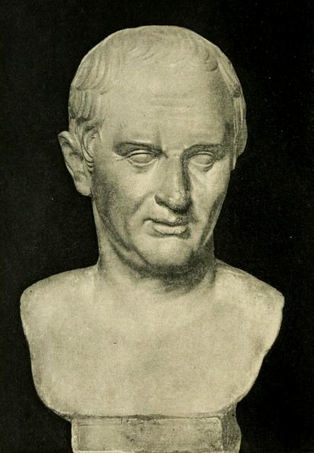
Marcus Tullius Cicero (106 –
43 BC).
  .jpg) 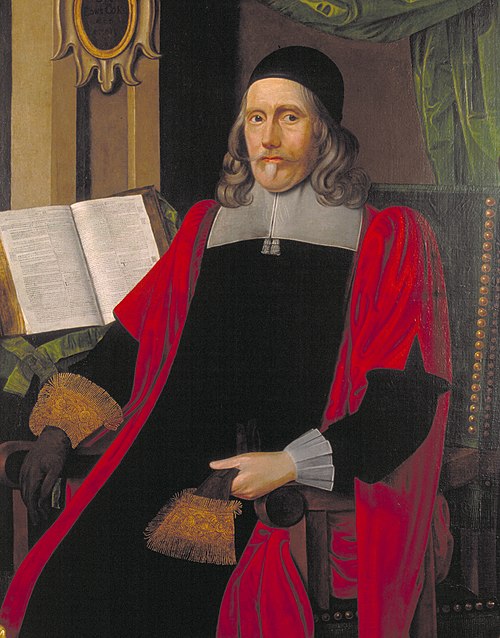
Marble bust of Marcus Tullius
Cicero at age 60 by unknown sculptor
(Source: Wikimedia Commons)
Frederick II and his falcon from his book De
arte venandi cum avibus (The
Art of Hunting with Birds),
1240s, artist unknown (Source: Wikimedia Commons)
Edward III wearing Order of the Garter
miniature from illuminated manuscript Bruges
Garter Book by William Bruges,
circa 1430s (Source: Wikimedia Commons)
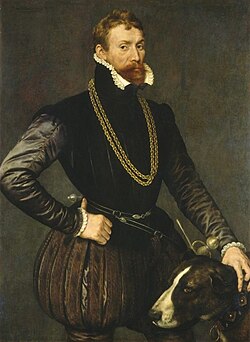
Sir Edward Coke, Chief Justice of the King's
Bench, portrait by Gilbert Jackson, 1615, in
Guildhall Art Gallery (Source: Wikimedia Commons)
One of the earliest laws against piracy was passed
by Holy Roman Emperor Frederick II in 1220. It
likened pirates to “enemies of Christendom.” (Barbary,
21) Pirates had become such a problem for the
Genoese that they established the Office of Pirates
in 1301, to pay recompense to foreign merchants who
fell victim to pirates from the city. Before the
middle of the fourteenth century, England labeled
piracy as a crime of common law and such criminals
were prosecuted in the assizes. Instead of rendering
verdicts according to the facts in the case, the
juries saw the accused as kindred spirits because
they were peers. Thus, many trials ended in
acquittals for the defendants. During Edward III’s reign, this
happened so often that he proclaimed piracy a form
of treason, and as such, would henceforth be tried
in a court of Admiralty. A schism erupted between
the crown and the assizes, and jurisdiction remained
an issue until Henry VIII’s reign (1509-1547).
 During
the reign of his father (Henry VII, 1584-1509),
plundering at sea had gotten way out of hand.
“[D]ivers and manifold spoliations and robberies be
daily had, committed, and done upon the sea”; the
victims, often his allies, complained persistently.
(Tudor, 25) The offenders even had the gall
to sell the ill-gotten wares in English ports
“contrary to the laws and statutes of this land, in
violation and in breach of the foresaid leagues,
confederations, and amities, and in grievous
contempt of our said sovereign lord.” (Tudor,
25) Therefore, King Henry issued a proclamation
“Ordering Punishment of Piracy against England’s
Allies” on 17 November 1490. During
the reign of his father (Henry VII, 1584-1509),
plundering at sea had gotten way out of hand.
“[D]ivers and manifold spoliations and robberies be
daily had, committed, and done upon the sea”; the
victims, often his allies, complained persistently.
(Tudor, 25) The offenders even had the gall
to sell the ill-gotten wares in English ports
“contrary to the laws and statutes of this land, in
violation and in breach of the foresaid leagues,
confederations, and amities, and in grievous
contempt of our said sovereign lord.” (Tudor,
25) Therefore, King Henry issued a proclamation
“Ordering Punishment of Piracy against England’s
Allies” on 17 November 1490.
Our said
sovereign lord the King . . . straightly
chargeth and commandeth that no manner of
person, of what estate, degree, or condition he
be of, from henceforth comfort, take, nor
receive in any of the said ports or other places
of this his realm any of the said misdoers; nor
any merchandises or goods by them spoiled or
taken from any of the said subjects in any
manner of wise, buy or otherwise receive; upon
pain of forfeiture of the same merchandises or
goods, in or to the value thereof, for
restitution thereof to be made to the parties
grieved, and upon pain of imprisonment of their
bodies and otherwise to be punished at the
King’s will. (Tudor, 25-26)
In other words, pirates
who dared to attack friendly ships and dared to sell
their booty would lose their property and be
imprisoned. If further punishment was in order, the
king could inflict whatever he deemed fitting.
His son, Henry VIII, ordered his navy
to pursue pirates and other wayward sea rovers. Four
years after his appointment as Deputy Lord of
Ireland, Sir William Skeffington
encountered a pirate named Broode in 1534. Broode’s
ship wrecked on the shore near Drogheda, and the
mayor and his men rounded up the pirates. In
February 1535, they were hanged, drawn, and quartered
following their trial. But not for piracy. From the
Crown’s perspective, Broode and his men had
committed acts of treason against the king.
Just as Queen Elizabeth excused Lady Killigrew’s egregious
acts, so could juries. This stemmed from the jurors’
perception of who was a pirate and what constituted
piracy, regardless of what the prosecutor and judge
told them. Sometimes, this was because those who
committed such acts did so to survive, especially
during Tudor times. On other occasions, those who
sat in judgement knew the accused; or had dipped
into their purses to acquire pillaged goods for what
they deemed a fairer price than if the items had
first gone through customs; or had provided
necessities that England refused to supply. Every
now and then, jurors didn’t believe defendants were
guilty of piracy if they attacked ships belonging to
non-Christians.
In 1565, Thomas Cobham and Thomas Stukeley were
particularly notorious for their “adventuring.” They
were arrested in May and put on trial, but the jury
acquitted Cobham. Since the High Court of Admiralty
judge suspected this might happen – he thought some
or all of the twelve jurors “were biased or perhaps
bribed” – he took the precaution of only allowing
the Crown to charge the accused with a few crimes.
This allowed him to have Cobham rearrested on new
charges after the jury “had absolved the prisoner.”
(Appleby, 95) Then the Admiralty judge confronted
the jury. Having rendered a false verdict, they had
two options: pay a fine of £20 or serve six months
in gaol. All were also “put in the pillory with
papers stuck on them like a cuirass.” (Appleby, 95)
Cobham was tried again and, this time, he was
to be
taken to the Tower, stripped entirely naked, his
head shaved, and the soles of his feet beaten,
and then, with his arms and legs stretched, his
back resting on a sharp stone, a piece of
artillery is to be placed on his stomach too
heavy for him to bear but not heavy enough to
kill him outright. In this torment he is to be
fed three grains weight of barley and the
filthiest water in the prison until he die.
(Appleby, 95)
His relatives weren’t
keen on this punishment, so they sought a pardon.
Before their request was granted or denied, Cobham
claimed benefit of clergy, which allowed him to show
that he could read Latin just like priests could.
Therefore, being literate, “he could not be done to
death, by the laws of the realm.” (Appleby, 95 &
97) Thomas Stukeley, on the other hand, escaped even
being tried because the evidence against him was too
weak.
World and national events can also impact the
context of what constitutes piracy, which in turn,
affects how laws are interpreted. This
interpretation can then change the laws themselves.
For example, piracy is an act of treason against
whoever rules the country under English law. Then a
period of unrest comes during the late seventeenth
century over who shall rule the country – a Catholic
monarch or a Protestant one. This results in the
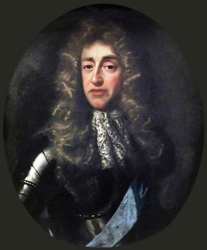
Stuart king, James II, fleeing England
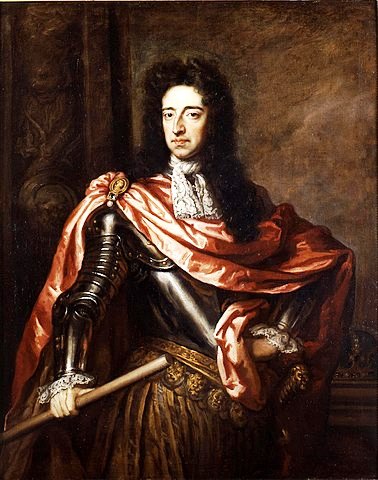
after his son-in-law, William of Orange invades. As
far as Parliament sees it, James has abdicated.
James disagrees; he’s merely ruling from afar and
prepares to regain his throne by launching an attack
from Ireland in 1689. One step in accomplishing this
goal is to grant letters of marque to eight
privateers, but when these men are captured and
stand trial five years later, they are charged with
treason. As far as the court sees this, “King James
had lost his sovereignty, in that he has parted with
his crown, and consequently with the power of
granting such commissions.” (Craze, 662) Per this
thinking, James’s letters of marque are invalid and
therefore, the men are committing piracy.
Enter William Oldish (Oldys), an Admiralty lawyer
for the defense who doesn’t rubber stamp this
conclusion. To his way of thinking, everyone and
every institution is equal before the law and the
law must be applied the same without regard to
politics and religion. Since James II is forced to
flee England, his abdication is involuntary and
isn’t recognized by international law. Therefore,
he
still had
a right to wage war and to deploy the tools of
war at his disposal, such as the power to grant
letters of marque, because ‘a king may be
deposed of his crown, but cannot lose his
right.’ (Craze, 663)
Of course, this conflicts
with the government’s perspective, so Oldish is
ousted as the defense advocate. Someone more
compliant is assigned to the case and the trial
proceeds.
While
the combination of Irish identity and probable
Catholicism, plus allegiance to James, weighted
the trial heavily against the men, the Court
convicted only six of the men, with the two
executions being for treason, not piracy. Two
years later, the court pardoned the remaining
four on condition of transportation to America
for seven years. (Craze, 665)
Even though this case
involved privateers, it impacted the question at
hand: What was a pirate? The legal definition
changed, which resulted in a change in the law.
Until this time “piracy” was considered a crime of
treason under the 1536 Offences at Sea Act, and this
law served as the basis for the privateers’ trial in
the first place.3 Based on
Oldish’s thinking, loyalty to sovereign was a matter
of personal choice rather than an obligation. This
contradicted the definition of treason, and
therefore, what the privateers did was actually
steal property rather than defy the king. As a
result, Parliament passed the 1698 Piracy Act. There
was just one caveat: this law had an expiration date
of 1705. Three years later, the Cruizers and Convoy
Act or 1708 Prize Act was enacted, essentially
resurrecting that old favorite, the 1536 Offences at
Sea Act, which defined piracy as an act of treason.
Another nine years passed before Parliament changed
piracy back to a crime of property, rather than
treason, with the 1717 Piracy Act.
 What was the 1536
Offences at Sea Act? This piece of legislation came
into being during Henry VIII’s reign. It was
also a time when a primary purpose of the English navy was to ferry
troops from home to wherever they were needed
abroad, usually mainland Europe but sometimes
elsewhere in the British Isles, as opposed to
defending the seas. That task fell to armed merchant ships that
attacked the enemy’s commerce (basically the same
thing that pirates did). Not all of these armed
merchant ships did so legally, and King Henry needed
a way to prosecute those who plundered without the
required legal writ, usually a letter of marque and
reprisal. He also strove to rectify the
fourteenth-century schism between the courts of
assizes and the courts of admiralty. Thus,
Parliament enacted 28 Henry VIII c. 15 (also known
as the 1536 Offences at Sea Act).4 What was the 1536
Offences at Sea Act? This piece of legislation came
into being during Henry VIII’s reign. It was
also a time when a primary purpose of the English navy was to ferry
troops from home to wherever they were needed
abroad, usually mainland Europe but sometimes
elsewhere in the British Isles, as opposed to
defending the seas. That task fell to armed merchant ships that
attacked the enemy’s commerce (basically the same
thing that pirates did). Not all of these armed
merchant ships did so legally, and King Henry needed
a way to prosecute those who plundered without the
required legal writ, usually a letter of marque and
reprisal. He also strove to rectify the
fourteenth-century schism between the courts of
assizes and the courts of admiralty. Thus,
Parliament enacted 28 Henry VIII c. 15 (also known
as the 1536 Offences at Sea Act).4
Where
Traytors, Pirates, Thieves, Robbers, Murtherers
and Confederates upon the Sea, many Times
escaped unpunished, because the Trial of their
Offences hath heretofore been ordered, judged
and determined before the Admiral, or his
Lieutenant or Commissary, after the course of
the Civil Laws,
(2) the Nature whereof is, that before any
Judgment of Death can be given against the
Offenders, either they must plainly confess
their Offences (which they will never do without
Torture or Pains) or else their Offences be so
plainly and directly proved by Witness
indifferent, such as saw their Offences
committed, which cannot be gotten but by Chance
at few Times, because such Offenders commit
their Offences upon the Sea, and at many Times
murther and kill such Persons being in the Ship
or Boat where they commit their Offences, which
should witness against them in that Behalf; and
also such as should bear witness be commonly
Mariners and Shipmen, which, because of their
often Voyages and Passages in the Seas, depart
without long tarrying and Protraction of Time,
to the great Costs and Charges as well of the
King’s Highness, as such as would pursue such
Offenders:
(3) For Reformation whereof, be it enacted by
the Authority of this present Parliament, That
all Treasons, Felonies, Robberies, Murthers and
Confederacies hereafter to be committed in or
upon the Sea, or in any other Haven, River,
Creek or Place where the Admiral or Admirals
have or pretend to have Power, Authority or
Jurisdiction, shall be inquired, tried, heard,
determined and judged . . . as if any such
Offence or Offences had been committed or done
in or upon the Land;
(4) and such Commissions shall be . . . directed
to the Admiral or Admirals . . . to hear and
determine such Offences after the common Course
of the Laws of this Realm, used for Treasons,
Felonies, Murthers, Robberies and Confederacies
of the same, done and committed upon the Land
within this Realm. (Rubin, 397-398)
In essence, whether you
were accused of piracy, theft, robbery, and/or
murder, or participated in one of these acts, you
would be tried under the same rules and regulations
as a traitor. And your trial would be conducted on
land. Before 1536, suspects were tried under civil
law and, if convicted, were sentenced to death. The
problem was in order to receive that judgment, the
accused pirate had to freely confess his crime(s) or
impartial witnesses to the crime must testify to
what they saw. The only way a pirate was likely to
fess up was if the authorities tortured him, which
left eyewitness testimony necessary. Except such
witnesses could only swear to those events that they
actually saw and they could not have been a
participant in the crime, or have an axe to grind,
or have an ulterior motive for bringing down the
pirate. It was also difficult to get such witnesses
to testify because of the transitory nature of being
seamen; most of their time was spent at sea rather
than on land, making it difficult for them to be
available for the trial. This supposed that the
officials could even find such a witness, since many
were killed by the pirates to prevent them from
testifying in the first place.
To alter such an outcome of piracy trials, the
judges were now required to hear these cases under
Admiralty rules, although actual verdicts of guilt
or innocence would be determined by “twelve lawful
Men.” (Rubin, 398) One additional modification was
that the accused could no longer claim “Benefit of
his or their Clergy,” to escape punishment.5
(Rubin, 398)
Notes:
3. At the time, the only other
law that had been passed since that year was the
1670 Piracy Act. It did not serve the Admiralty
court's purposes because it required the master and
seamen of a merchant ship to stop the pirates from
taking their ship. (This placed the onus on the
victims, rather than the government, when it came to
suppressing piracy.)
4. The 1536 Offences at Sea Act
was extended to Ireland in 1613, making Irish law
align with English law.
5. The 1536 Offences at Sea Act
would not be repealed until 2003.
Resources (The list is so
extensive that I have placed it on a separate page.)
Copyright ©2025 Cindy Vallar

Click to contact me
Background image compliments
of Anke's Graphics |
.jpg)