 Pirates and Privateers Pirates and Privateers
The History of Maritime
Piracy
Cindy Vallar, Editor
& Reviewer
P.O. Box 425,
Keller, TX 76244-0425

Suppressing a
Proliferation
Law & Order: Pirate Edition (part 5)
by Cindy Vallar
[I]n the
Afternoon my lieutenant returned aboard and
informed me that he was receiv’d by a great
number of pyrates with much civility to whom he
read the publick the proclamation . . . .
(Hahn, 94)
Captain Vincent Pearse,
commander of HMS Phoenix, recorded this
entry in his log on 24 February 1718. His ship was
anchored in a harbor surrounded by pirate ships.
Ashore, his lieutenant had ventured into the
pirates’ lair to extend a peace offering. Two
hundred nine pirates, including Benjamin Hornigold, would take
advantage of the king’s offer, the first step in
Britain’s attempt to suppress piracy following the War
of the Spanish Succession.
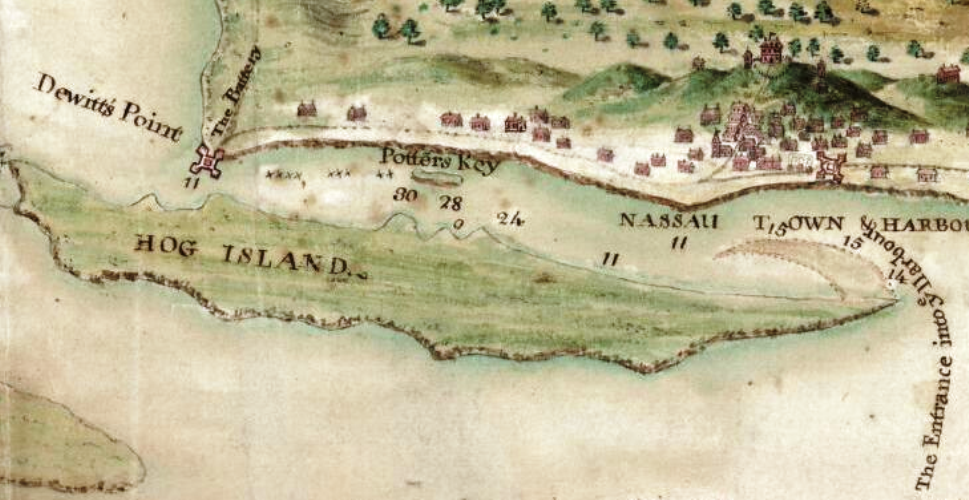
Enlargement of 1715 map of New
Providence.
To the left at Dewitt's Point is the fort. To
the right along the shore of the town harbor
is the redoubt.
(Source: Wikimedia Commons)
Between 1716 and 1726, roughly 4,000 pirates roved
the seas. They posed a significant threat to British
colonists, commerce, and law and order. To bring all
of them to justice would have taken an inordinate
amount of manpower and expense. For this reason,
King George I opted to employ a carrot-and-stick
policy in 1717.
[W]e do
hereby promise and declare, that in case any of
the said Pirates shall, on or before the fifth
Day of September, in the Year of our Lord One
thousand seven hundred and eighteen, surrender
him or themselves to one of our Principal
Secretaries of State in Great Britain or
Ireland, or to any Governour or Deputy Governour
of any of our Plantations or Dominions . . .
every such Pirate and Pirates so surrendering .
. . shall have our gracious Pardon of and for
such his or their Piracy or Piracies, by him or
them committed before the fifth Day of January
next ensuing. (By the King)
If pirates chose not to
take advantage of the amnesty,
[W]e do
hereby strictly Charge and Command all our
Admirals, Captains, and other Officers at Sea,
and all our Governours and Commanders of any
Forts, Castles, or other Places in our
Plantations, and all other our Officers Civil
and Military, to seize and take such of the
Pirates who shall refuse or neglect to surrender
themselves accordingly. (By the King)
In addition, bounties
would be awarded to anyone who brought a pirate to
justice:
for every
Commander of any Pirate Ship or Vessel the Sum
of One hundred Pounds; for every Lieutenant,
Master, Boatswain, Carpenter, and Gunner, the
Sum of Forty Pounds; for every inferior Officer
the Sum of thirty Pounds; and for every Private
Man the sum of twenty Pounds. (By the King)
Should a pirate decide to
turn on his crew mates after 6 September 1718, and
the pirate captain was convicted of his crimes, the
turncoat would earn a reward of £200.
To show that he meant business, the king sent “a
proper Force to be employed for Suppressing the said
Piracies” that consisted of “three fifth-rate
vessels of forty guns each, one sixth rate of twenty
guns and a sloop” to the West Indies; a fifth rate,
a sixth rate, a sloop, and “the forty-gun Pearl”
to Virginia; and “three twenty-gun sixth-rates” to
New England. (Brooks, 374) The primary purpose of
these Royal Navy ships was not to hunt pirates;
rather, they were to protect shipping and intercept
pirates who dared to attack merchant vessels and
inhibit trade.
How effective would these twelve warships be? That
depended on a variety of factors:
a. the
geography and vastness of the region each was to
patrol;
b. their sizes as
compared to those of the pirates;
c. unclean hulls that
slowed down ships and weakened the planks,
allowing for leaks;
d. diseases that
plagued sailors unused to serving in the
Caribbean; and
e. the element of
autonomy that allowed naval captains to refuse
what governors wanted them to do.
Still, King George’s
dispersal was a start, and the Royal Navy would be
more effective in suppressing piracy as the years
passed.
Another decision of the King’s was to put an end to
the private charter given to the proprietors of
Carolina, and to send Woodes Rogers to the Bahamas as its royal governor.
His task was to oust the pirates from New Providence
and restore law and order.
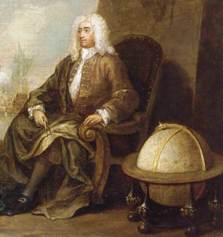 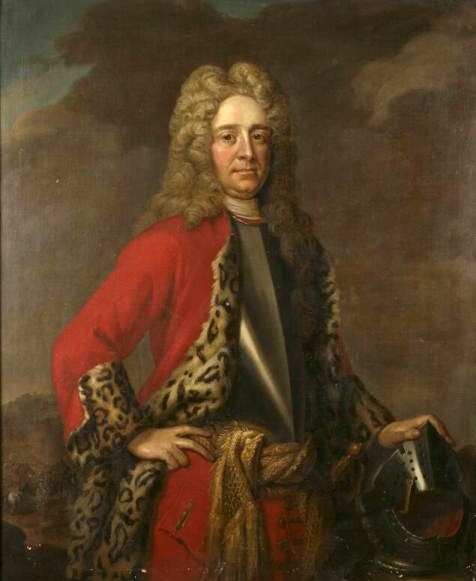
Left: Governor Woodes Rogers
from family portrait by William Hogarth in
1729
Right: Governor Robert Hunter portrait
attributed to Godfrey Kneller in 1720
(Sources: Wikimedia Commons and Wikimedia Commons)
King George’s proclamation wasn’t the first one
issued during this period rife with piracy. Governor
Robert Hunter of New York had issued one in July
1717. It demonstrated that the colony’s interests
were finally on the same page as the Crown’s.
Instead of colluding with pirates, as was common in
earlier years, this proclamation made it clear that
the colonists and sea rovers were now enemies.
Nor was New York the only colony that began cracking
down on pirates. In October 1717, Massachusetts
brought charges against eight pirates for the first
time since John Quelch’s trial. This time
around, the defendants were members of Sam Bellamy’s crew: Simon Van
Vorst, John Brown, Thomas Baker, Hendrick Quintor,
Peter Cornelius Hoof, John Shuan, Thomas South, and
Thomas Davis. The charges against them involved
“piracy, robbery & felony committed on the high
sea.” (Trials, unnumbered) Prior to pleading,
they requested assistance from an attorney, and
Robert Auchmuty was chosen. One of his objections
involved the laws under which they were being tried:
That the
Commission of the late Queen Anne was of no
force after Her Majesty’s Demise: And so the
Court had no Power to act by vertue of the said
Commission, It having dyed with the Queen: And
several Authorities in the Law were Cited and
Insisted upon . . . . (Trials, 4)
The court said the
opposite was true.
[T]he
Proclamation of His present Majesty King GEORGE,
for Continuing Officers, and the subsequent
Commission, and the Instructions from the Crown
lately Transmitted to the Governour, referring
to the Pirates was a sufficient justification of
the above-mentioned Act, which was still in full
force; and that the cases which had been Cited,
were not to the purpose. (Trials, 4)
The defendants pleaded
not guilty. The trial began the next day with the
Advocate General orating on the egregiousness of
piracy.
Now as
Piracy is in its self a complication of Treason,
Oppression, Murder, Assassination, Robbery and
Theft, so it denotes the Crime to be perpetrated
on the High Sea . . . whereby it becomes more
Atrocious.
First, Because it is done in
remote and Solitary Places, where the weak and
Defenceless can expect no Assistance nor Relief;
and where these ravenous Beasts of Prey may
ravage undisturb’d, hardned in their Wickedness
with hopes of Impunity, and of being Concealed
for ever from the Eyes and Hands of avenging
Justice. One of the most aggravating
Circumstances, that attend a Crime, is the
facility of it’s being committed, that is, where
the Malefactor cannot easily be prevented nor
discovered. Thus by the Law of GOD Theft in the
Field was more grievously Punished, than Theft
in a House. . . .
Another Aggravation of this Crime
is, That the unhappy Persons on whom it is
acted, are the most innocent in themselves, and
the most Useful and Beneficial to the Publick; .
. . Ships are under the Publick Care . . .
Masters of Ships are Publick Officers, and
therefore every Act of Violence and Spoliation
committed on them or their Ships, may justly be
accounted Treason, and so it was before the
Statute of the 25th of Edward III.
The Third Circumstance,
which blackens exceedingly and augments a
Pirates Guilt, is the Danger, wherewith every
State or Government is threatned from the
Combinations, Conspiracies and Confederacies of
Profligate and Desperate Wretches, united by no
other tie . . . than a mutual Consent to
extinguish first Humanity in themselves, and to
Prey promiscuously on all others. (Trials,
6-7)
After this explanation
regarding “the Nature and Effects of Piracy in
General,” he then addressed “Principles of the Civil
Law” that the court was obligated to follow and
which dictated appropriate punishments for the crime
if the defendants were convicted. Only after this
were witnesses called. The defendants also offered
their testimonies. Van Vorst, Brown, Baker, Quintor,
Hoof, and Shuan were found guilty, but South was
acquitted. As per the law, the six felons
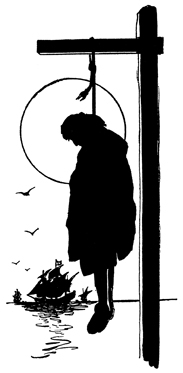 shall go hence to the Place from
whence you came, and from thence you shall be
carryed to the Place of Execution, and there you
and each of you, shall be hanged up by the Neck
until you & each of you are Dead; And the
Lord have Mercy on your Souls. shall go hence to the Place from
whence you came, and from thence you shall be
carryed to the Place of Execution, and there you
and each of you, shall be hanged up by the Neck
until you & each of you are Dead; And the
Lord have Mercy on your Souls.
And the
Court do also ordain, That all your Lands,
Tenements, Goods and Chattles be forfeited to
the King, and brought into His Majesty’s use.
(Trials, 14)
The convicted pirates
were hanged on 15 November “at Charlestown Ferry
within flux and reflux of the Sea.” (Trials, 14)
As for Thomas Davis, the vice-admiralty court heard
his case on 28 October. Since Thomas South had been
acquitted, he could now appear as a witness. He
explained that Davis had been forced to join the
pirates, who refused to allow him his freedom
because of his carpentry skills. “[T]hey would shoot
him before they would let him go from them.” (Trials,
19) Several others testified on his behalf as well.
When it was Davis’s turn to speak, he explained how
he came to be aboard the pirate ship and how he
survived her sinking.
John Valentine, an attorney whom the court had
chosen to speak for Davis, then said,
if he
believed the Prisoner to be guilty of the
crimes, for which he was Indicted, he should not
appear on his behalf: That he hoped this
Honourable Court upon consideration that there
was little or nothing said, much less proved
against the Prisoner, they would acquit him as
being Innocent, for that in all Capital crimes
there must be down-right Proofs and plentiful
Evidence to take away a Mans Life . . . . (Trials,
20)
Although the prosecutor
did not concur and had quite a lot to say on Davis’s
guilt, the Court “were of Opinion that there was
good proof of the Prisoners being forced on board
the Pirate Ship . . . which excused his being with
the Pirates; and that there was no Evidence to prove
that he was Accessory with them, but on the contrary
that he was forced to stay with them against his
Will.” (Trials, 22) The verdict? Not Guilty.
Notwithstanding the warships sent to suppress
piracy, or the fact that King George extended his
Act of Grace to incorporate piracies committed
through 5 January 1719, and that pirates then had
until 1 July 1719, to turn themselves in, piracy
remained a problem. Governors repeatedly sought
additional help from London. Such requests either
fell on deaf ears or weren’t reacted to in a timely
manner.
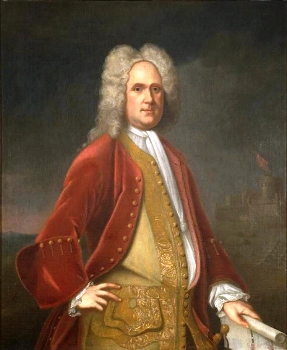 In
July 1718, Lieutenant-Governor Alexander Spotswood,
never a friend of pirates, grew concerned at the
presence of such scoundrels in his colony. He shared
with Virginia’s Council that In
July 1718, Lieutenant-Governor Alexander Spotswood,
never a friend of pirates, grew concerned at the
presence of such scoundrels in his colony. He shared
with Virginia’s Council that
Severall .
. . Pirates have Since come into this Colony
with Certificates from the Governor of No
Carolina of their Surrendering to him, but in
regard their Travelling about the Country with
their Arms and keeping together in Considerable
Numbrs give Great Suspicion, that they design to
betake themselves again to Piracy. (Executive,
481)
As a result, Spotswood
issued a proclamation that insisted that
all Persons who have been concerned in any
Piracys, and who shall come into this Colony
immediately upon their Arrival, to deliver up
their Arms to the first Justice of the Peace or
Milletary Officer, and prohibiting them to
Associate in any Greater Numbers than three in one
Company And that in Case any be found going armed,
or in Greater Numbers than is above Expressed,
That the Justices of the Peace Cause them to be
taken up and put in Prison till they give Security
for their good behavior. (Executive,
481-482)
To his way of thinking, this proclamation was not
enough. Fed up with North Carolina’s failings when
it came to dealing with pirates, and desiring to
prevent the pirates from adversely affecting
Virginia’s trade, Spotswood took matters into his
own hands.
[H]aving
at the same time received complaints from . . .
the trading people [of North Carolina] of the
insolence of [Thache and] that gang of pyrates,
and the weakness of that Governmt. to restrain
them, I judged it high time to destroy that crew
of villains, and not to suffer them to gather
strength[.] (America, 800)
He gathered the necessary
intelligence about Blackbeard and his men, and
solicited help from pilots familiar with North
Carolina waters. He met with the warship captains
stationed at Virginia and they formulated a plan. At
his expense,
I hyred
two sloops and put pilotes on board, and the
Captains of H.M. ships having put 55 men on
board under the command of the first Lieutenant
of the Pearle and an officer from the Lyme,
they came up with Tach at Ouacock Inlett on the
22nd of last month. (America, 800)
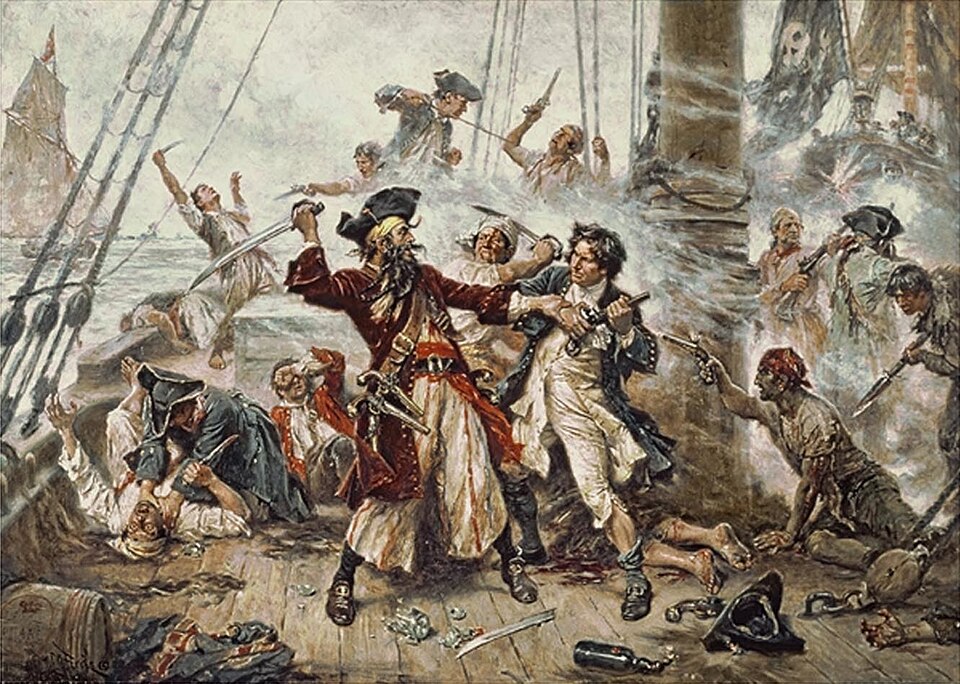
In the ensuing fight against Robert Maynard and his
men, “Tach with nine of his crew were killed, and
three white men and six negros were taken alive but
all much wounded.” (America, 800) The Royal Navy
lost eleven men and another twenty-three sustained
wounds. As to why Spotswood chose not to get prior
approval, he explained, “I did not communicate to
the Assembly nor Council, the project then forming
agt. Tach’s crew for fear of his having
intelligence, there being in this country and more
especially among the present faction, an
unaccountable inclination to favour pyrates . . . .”
(America, 800)
Governing a colony far from home often meant the
governors, like Spotswood, were left to their own
devices when it came to dealing with pirates.
Guidance in the specifics of what to do was either
sparse or not forthcoming. In 1661, during his
tenure as governor of Jamaica, Colonel Edward
D’Oyley (or Doyley) arrested the men who sailed
aboard Betty and Pearl because
they had attacked a Dutch vessel. Since these were
the early days of the English colony, there was no
gaol in which to imprison them. Instead, their
sentences involved manual labor on the plantations
of the island’s various officers. If anyone thought
to succor these men, the colonel proclaimed not to
comfort or
abet the said Theeves and piratts nor any waies
promote advise or consort upon pain of being
prosecuted as accessories to the said Robbery
and piracy in according to the law. (Hanna,
103)
To make certain the
residents specifically knew who these men were, he
had them wear arrows on their necks. This punishment
lasted for as long as he thought them unrepentant.
One was a young man named “henry Morgan, souldier.”
(Hanna, 103)
With navies stretched thin and governments focused
more on European events than West Indian ones,
colonial governors sometimes improvised to protect
their domains. In 1665, manipulation of the law was
the sleight of hand that Jamaican governor Sir
Thomas Modyford employed. Authorities in London
expected him to implement the law and heed their
instructions, but they weren’t on the scene and
didn’t necessarily understand the full picture. He
randomly selected fourteen pirates and put them on
trial. Since they were found guilty, according to
the 1536 Offences at Sea Act, they were to be
hanged. Except, the whole trial had been rigged to
show England that he was maintaining law and order
on the island. Now that he had achieved that aim, he
pardoned the condemned and commissioned them to go
privateering against the Dutch since England was at
war with them.
Even pirates tried to manipulate the law to their
advantage. George Cusack was caught in a
compromising position and arrested in England in
1674. After the indictment was read against him and
five others, he was asked to plead, but
first took
some exceptions to the Jury; not for any
prejudice against any particular men of them;
but because they were Citizens; who did not (he
said) understand Maritime-Affairs. . . .
Sea-Captains, and Masters of Ships should have
been Impannell'd. . . . [H]e cryed out, We will
be Tryed (my Lord) by men of our own Trade!
Which being understood in another sence, made
not only the Audience, but his fellow Prisoners
to laugh heartily. (Grand, 30)
The Court overruled his
objection, perhaps because the current jury was more
likely to find him guilty, whereas if men of the sea
sat in judgment, they were more likely to acquit him
since they tended to protect their own.
This Mr.
Cusack appeared to be a Person of a Clear
Courage, and good understanding: he pleaded very
well for his life; but the matter was too foul
to be washt off with good words. (Grand,
31)
He and the other
defendants were found guilty and hanged in 1675.
To be continued . . .
Resources (The list is so
extensive that I have placed it on a separate page.)
Copyright ©2025 Cindy Vallar

Click to contact me
Background image compliments
of Anke's Graphics |
