 Pirates and Privateers Pirates and Privateers
The History of Maritime
Piracy
Cindy Vallar, Editor
& Reviewer
P.O. Box 425,
Keller, TX 76244-0425

A New Nation Joins the
Fight against Piracy
Law & Order: Pirate Edition (part 6)
by Cindy Vallar
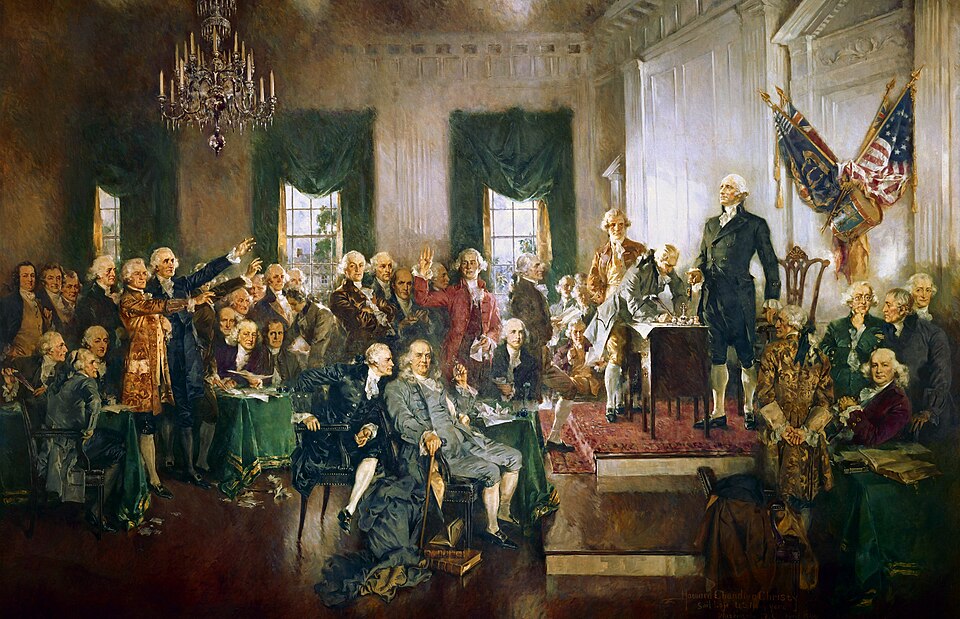
Scene at the Signing of the
Constitution of the United States by Howard
Christy Chandler (1940)
(Source: Wikipedia Commons)
After the American
colonies became the United States of America, the Founding
Fathers needed new principles and laws to
guide and protect the country and her people. This
included defining piracy and identifying a fitting
punishment for those convicted of the offense. Congress was granted the power
to deal with these issues in Article I, Section 8 of
the Constitution of the United States
(1789).
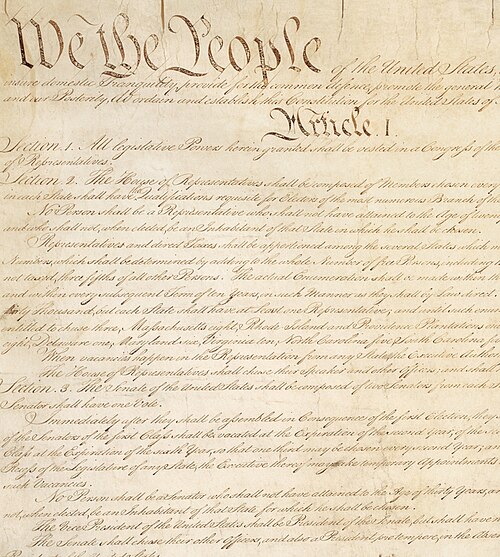 The Congress shall have Power .
. . To define and punish Piracies and Felonies
committed on the high Seas, and Offences against
the Law of Nations. (Constitution) The Congress shall have Power .
. . To define and punish Piracies and Felonies
committed on the high Seas, and Offences against
the Law of Nations. (Constitution)
Now that it possessed
these rights, Congress needed to deal with
specifics. On 30 April 1790, it passed the Crimes
Act. Chapter IX, Sections 8 through 12 dealt
specifically with the crime of maritime piracy.
Sec. 8.
And be it [further] enacted, That if any person
or persons shall commit upon the high seas, or
in any river, haven, basin or bay, out of the
jurisdiction of any particular state, murder or
robbery, or any other offence which if committed
within the body of a county, would by the laws
of the United States be punishable with death;
or if any captain or mariner of any ship or
other vessel, shall piratically and feloniously
run away with such ship or vessel, or any goods
or merchandise to the value of fifty dollars, or
yield up such ship or vessel voluntarily to any
pirate; or if any seaman shall lay violent hands
upon his commander, thereby to hinder and
prevent his fighting in defence of his ship or
goods committed to his trust, or shall make a
revolt in the ship; every such offender shall be
deemed, taken and adjudged to be a pirate and
felon, and being thereof convicted, shall suffer
death; and the trial of crimes committed on the
high seas, or in any place out of the
jurisdiction of any particular state, shall be
in the district where the offender is
apprehended, or into which he may first be
brought.
Sec. 9. And be
it [further] enacted, That if any citizen shall
commit any piracy or robbery aforesaid, or any
act of hostility against the United States, or
any citizen thereof, upon the high sea, under
colour of any commission from any foreign
prince, or state, or on pretence of authority
from any person, such offender shall,
notwithstanding the pretence of any such
authority, be deemed, adjudged and taken to be a
pirate, felon, and robber, and on being thereof
convicted shall suffer death.
Sec. 10. And be
it [further] enacted, That every person who
shall, either upon the land or the seas,
knowingly and wittingly aid and assist, procure,
command, counsel or advise any person or
persons, to do or commit any murder or robbery,
or other piracy aforesaid, upon the seas, which
shall affect the life of such person, and such
person or persons shall thereupon do or commit
any such piracy or robbery, then all and every
such person . . . aiding, assisting, procuring,
commanding, counselling or advising the same,
either upon the land or the sea, shall be, and
they are hereby declared, deemed and adjudged to
be accessary to such piracies before the fact,
and every such person being thereof convicted
shall suffer death.
Sec. 11. And be
it [further] enacted, That after any murder,
felony, robbery, or other piracy whatsoever
aforesaid, is or shall be committed by any
pirate or robber, every person who knowing that
such pirate or robber has done or committed any
such piracy or robbery, shall on the land or at
sea receive, entertain or conceal any such
pirate or robber, or receive or take into his
custody any ship, vessel, goods or chattels,
which have been by any such pirate or robber
piratically and feloniously taken, shall be, and
are hereby declared, deemed and adjudged to be
accessary to such piracy or robbery, after the
fact; and on conviction thereof, shall be
imprisoned not exceeding three years, and fined
not exceeding five hundred dollars.
Sec. 12. And be
it [further] enacted, That if any seaman or
other person shall commit manslaughter upon the
high seas, or confederate, or attempt or
endeavour to corrupt any commander, master,
officer or mariner, to yield up or to run away
with any ship or vessel, or with any goods,
wares, or merchandise, or to turn pirate, or to
go over to or confederate with pirates, or in
any wise trade with any pirate knowing him to be
such, or shall furnish such pirate with any
ammunition, stores or provisions of any kind, or
shall fit out any vessel knowingly and with a
design to trade with or supply or correspond
with any pirate or robber upon the seas; or if
any person or persons shall any ways consult,
combine, confederate or correspond with any
pirate or robber on the seas, knowing him to be
guilty of any such piracy or robbery; or if any
seaman shall confine the master of any ship or
other vessel, or endeavour to make a revolt in
such ship; such person or persons so offending,
and being thereof convicted, shall be imprisoned
not exceeding three years, and fined not
exceeding one thousand dollars. (United
States Statutes)
Court cases helped to
refine the definitions within these statutes. United
States v. Palmer (1818), for example, was a
lawsuit in which John Palmer, Thomas Wilson, and
Barney Colloghan
with force
and arms, upon the high seas . . . did
piratically and feloniously set upon, board
break, and enter . . . Industria Raffaelli . . .
and did make an assault in and upon certain
persons . . . of Spain . . . [and] did, then and
there, steal, take and carry away five hundred
boxes of sugar, of the value of twenty thousand
dollars . . . sixty pipes of rum, of the value
of six thousand dollars; two hundred demijohns
of honey, of the value of one thousand dollars .
. . ten hogsheads of coffee, of the value of two
thousand dollars; and four bags of silver and
gold, of the value of sixty thousand dollars . .
. . (US v. Palmer)
 The
circuit court heard the case in 1817, but the judges
had questions that only the Supreme Court could answer. In
essence, one pertained to the fact that robbery on
land was not punishable by death, so neither should
piracy be punishable by death since it was just a
robbery that took place at sea. The Supreme Court
denied this, confirming that “[r]obbery committed on
the high seas did constitute an act of piracy, and
therefore was indeed punishable by death.” (Kraska,
110) The
circuit court heard the case in 1817, but the judges
had questions that only the Supreme Court could answer. In
essence, one pertained to the fact that robbery on
land was not punishable by death, so neither should
piracy be punishable by death since it was just a
robbery that took place at sea. The Supreme Court
denied this, confirming that “[r]obbery committed on
the high seas did constitute an act of piracy, and
therefore was indeed punishable by death.” (Kraska,
110)
A second question concerned the fact that the owners
of the Spanish ship were unknown, as were the seamen
who crewed her. Therefore, did this make a
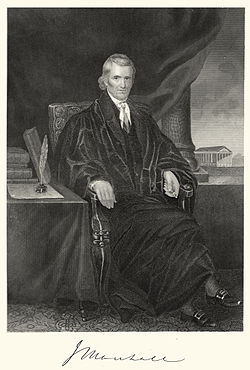
difference since they were not American citizens? Chief
Justice John Marshal wrote:
The
question, whether this act extends farther than
to American citizens, or to persons on board
American vessels, or to offences committed
against citizens of the United States, is not
without its difficulties. The constitution
having conferred on congress the power of
defining and punishing piracy, there can be no
doubt of the right of the legislature to enact
laws punishing pirates, although they may be
foreigners, and may have committed no particular
offence against the United States. . . .
[but t]he words
of the section are in terms of unlimited extent.
The words 'any person or persons,' are broad
enough to comprehend every human being. But
general words must not only be limited to cases
within the jurisdiction of the state, but also
to those objects to which the legislature
intended to apply them. (US v. Palmer)
As a result,
[t]he
court is of opinion that the crime of robbery,
committed by a person on the high seas, on board
of any ship or vessel belonging exclusively to
subjects of a foreign state, on persons within a
vessel belonging exclusively to subjects of a
foreign state, is not a piracy within the true
intent and meaning of the act for the punishment
of certain crimes against the United States.
(US v. Palmer)
This decision “clarified
the definition of piracy as being the act of
robbery, as recognized and defined by common law,
committed on the high seas.” (Kraska, 110) However,
since no American owned Industria Raffaelli,
the robbery committed by Palmer and the other two
men was not an act of piracy. Therefore, on 3 March
1819, Congress passed a new statute with a clearer
definition of piracy.
Piracy was
the act of robbery, as recognized and defined by
common law, committed on the high seas. However,
the crime of robbery by a non-U.S. citizen
committed on the high seas on board a vessel
owned by subjects of a foreign state was not
considered piracy under the Act of 1790, and as
such, was not punishable in the courts of the
United States. (Kraska, 111)
In 1820, Congress
broadened the definition of piracy to include
trafficking in slaves, but just for two years.
Congress changed its mind in 1823 and made the law
permanent. Section three covered the usual legal
definition of piracy, whereas sections four and five
concerned the slave trade.
SEC. 3. And be it further enacted, That, if any person
shall, upon the high seas, or in any open
roadstead, or in any haven, basin, or bay, or in
any river where the sea ebbs and flows, commit
the crime of robbery, in or upon any ship or
vessel, or upon any of the ship's company of any
ship or vessel, or the lading thereof, such
person shall be adjudged a pirate: and, being
thereof convicted before the circuit court of
the United States for the district into which he
shall be brought, or in which he shall be found,
shall suffer death. And if any person engaged in
any piratical cruise or enterprise, or being of
the crew or ships company of any piratical ship
or vessel, shall land from such ship or vessel,
and, on shore, shall commit robbery, such person
shall be adjudged a pirate: and on conviction
thereof before the circuit court of the United
States for the district into which he shall be
brought, or in which he shall be found, shall
suffer death: Provided, That nothing in this
section contained shall be construed to deprive
any particular state of its jurisdiction over
such offences, when committed within the body of
a county, or authorize the courts of the United
States to try any such offenders, after
conviction or acquittance, for the same
offence, in a
state court.
SEC. 4. And be it further enacted, That if any citizen of
the United States, being of the crew or ship's
company of any foreign ship or vessel engaged in
the slave trade, or any person whatever, being
of the crew or ship's company of any ship or
vessel, owned in the whole or part, or
navigated for, or in behalf of, any citizen or
citizens of the United States, shall land, from
any such ship or vessel, and, on any foreign
shore, seize any negro or mulatto, not held to
service or labour by the laws of either of the
states or territories of the United States,
with intent to make such negro or mulatto a
slave, or shall decoy, or forcibly bring or
carry, or shall receive, such negro or mulatto
on board any such ship or vessel, with intent as
aforesaid, such citizen or person shall be
adjudged a pirate; and, on conviction thereof
before the circuit court of the United States
for the district wherein he may be brought or
found, shall suffer death.
Sec. 5. And be it further enacted, That if any citizen of
the United States, being of the crew or ship's
company of any foreign ship or vessel engaged in
the slave trade, or any person whatever, being
of the crew or ship's company of any ship or
vessel, owned wholly or in part, or
navigated for, or in behalf of, any citizen or
citizens of the United States, shall forcibly
confine or detain, or aid and abet in forcibly
confining or detaining, on board such ship or
vessel, any negro or mulatto not held to service
by the laws of either of the states or
territories of the United States with intent to
make such negro or mulatto a slave or shall on
board any such ship or vessel, offer or attempt
to sell, as a slave, any negro or mulatto not
held to service as aforesaid, or shall, on the
high seas, or any where on tide water, transfer
or deliver over, to any other ship or vessel,
any negro or mulatto not held to service as
aforesaid, with intent to make such negro or
mulatto a slave, or shall land, or deliver on
shore, from on board any such ship or vessel,
any such negro or mulatto, with intent to make
sale of, or having previously sold, such negro
or mulatto, as a slave, such citizen or person
shall be adjudged a pirate; and, on conviction
thereof before
the circuit court of the United States for the
district wherein he shall be brought or found,
shall suffer death. (Loveman)
 This
was a new distinction in defining who was a pirate,
and the United States did enforce the law. It
brought seventy-four cases to trial under this
statute between 1837 and 1860, but none garnered the
attention or the notoriety that came when the United
States tried Nathaniel Gordon, master of a ship
carrying 897 Africans who were to be enslaved in
Cuba. USS Michigan captured Green’s Erie
and escorted her to New York where Gordon stood
trial for piracy. Most of those defendants in the
earlier cases were acquitted, and those who had been
deemed guilty received light sentences. Not so
Nathaniel Gordon; he was sentenced to death. Many
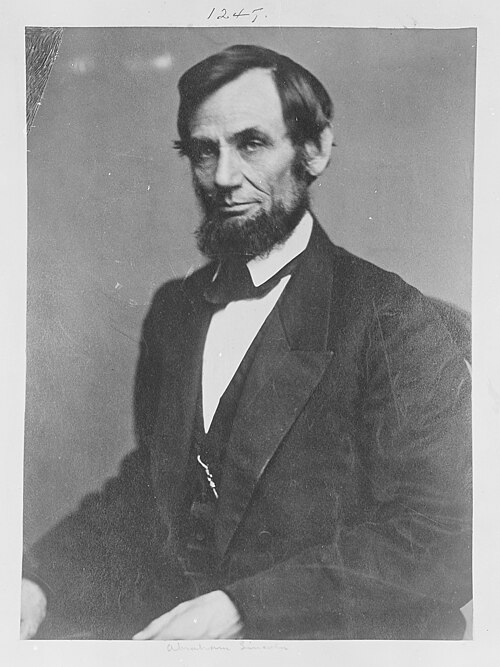
felt the sentence too harsh and wrote to President
Abraham Lincoln to ask for clemency. On 4 February
1862, Lincoln responded: This
was a new distinction in defining who was a pirate,
and the United States did enforce the law. It
brought seventy-four cases to trial under this
statute between 1837 and 1860, but none garnered the
attention or the notoriety that came when the United
States tried Nathaniel Gordon, master of a ship
carrying 897 Africans who were to be enslaved in
Cuba. USS Michigan captured Green’s Erie
and escorted her to New York where Gordon stood
trial for piracy. Most of those defendants in the
earlier cases were acquitted, and those who had been
deemed guilty received light sentences. Not so
Nathaniel Gordon; he was sentenced to death. Many
felt the sentence too harsh and wrote to President
Abraham Lincoln to ask for clemency. On 4 February
1862, Lincoln responded:
Whereas,
it appears that at a Term of the Circuit Court
of the United States of America for the Southern
District of New York held in the month of
November A.D. 1861, Nathaniel Gordon was
indicted and convicted for being engaged in the
Slave Trade, and was by the said Court sentenced
to be put to death by hanging by the neck, on
Friday the 7th day of February, A.D. 1862;
And whereas, a
large number of respectable citizens have
earnestly besought me to commute the said
sentence of the said Nathaniel Gordon to a term
of imprisonment for life, which application I
have felt it to be my duty to refuse;
And whereas, it
has seemed to me probable that the unsuccessful
application made for the commutation of his
sentence may have prevented the said Nathaniel
Gordon from making the necessary preparation for
the awful change which awaits him;
Now, therefore,
be it known, that I, Abraham Lincoln, President
of the United States of America have granted and
do hereby grant unto him, the said Nathaniel
Gordon, a respite of the above recited sentence,
until Friday the twenty first day of February,
A.D. 1862, between the hours of twelve o’clock
at noon and three o’clock in the afternoon of
the said day, when the said sentence shall be
executed.
In granting this
respite, it becomes my painful duty to admonish
the prisoner that, relinquishing all expectation
of pardon by Human Authority, he refer himself
alone to the mercy of the Common God and Father
of all men. (Lincoln)
Gordon's execution took
place on the assigned day, and a reporter for Harper’s
Weekly described the event.
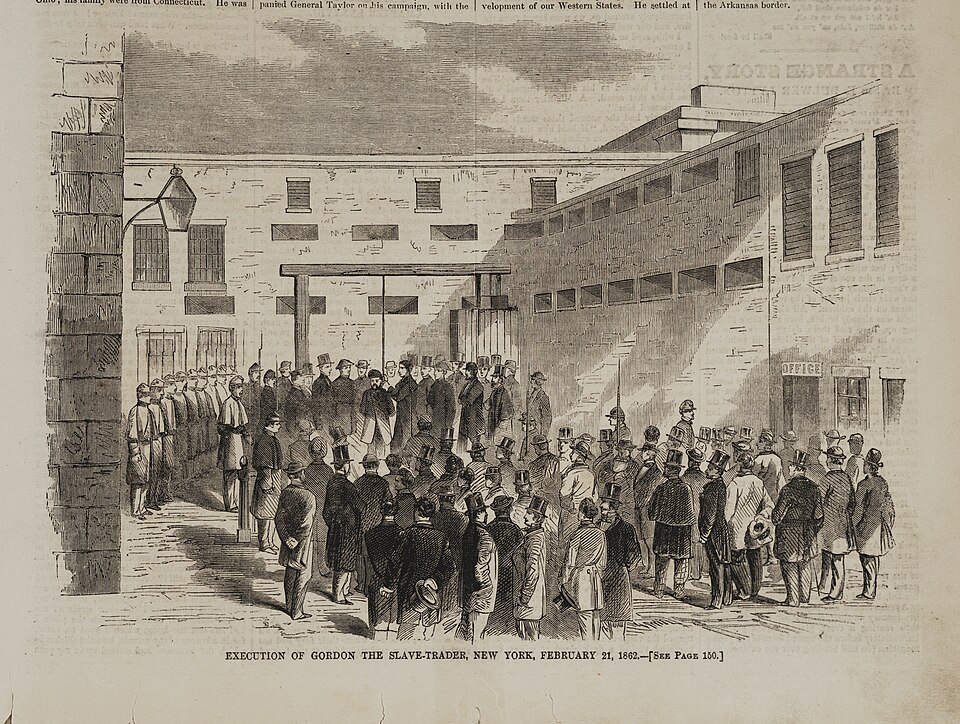
1862 Wood Engraving of
Nathaniel Gordon's Execution in New York on 21
February
(Source: Wikimedia Commons)
Deputy
Marshal Borst aided [Gordon] in dressing and
gave him a large drink of clear whisky, when his
arms were tied, the black cap was put carelessly
on one side of his head, and he was carried on
the deputy’s shoulders to a chair in the
corridor.
The sight was
simply shocking.
The man was not
sober . . . they had been obliged to give him
whisky enough to make an ordinary man drunk
three times over. He sat lullingly in the chair,
gazing listlessly around . . . [H]e was helped
to his feet, and held there while the Marshal
read to him the death-warrant.
After this he
looked around with a senseless smile, asked for
some more whisky, which was kindly given him.
The procession was then formed, Gordon stalking
with a bravadoish air, unheld by the Marshals,
toward the scaffold.
. . . When he
reached the scaffold, he said, “Well, a man
can’t die but once; I’m not afraid.” The cap was
drawn over the whitened, meaningless features,
the noose-knot was carefully adjusted under his
ear, and he stood, an unthinking, careless,
besotted wretch waiting for he knew not what,
when with a jerk he went high in the air, and
fell to the length of the rope, still senseless,
still unfeeling, still regardless of pain or
pleasure.
The body swayed
hither and thither for a few moments, and all
was quiet. No twitchings, no convulsions, no
throes, no agonies . . . he hung a lump of
dishonored clay. (Lincoln)
No other slave trader was
“tried, convicted, and executed in American
history.” (Spilman)
After 1823, tweaks were made to the piracy laws in
1835, 1846, 1847, and 1874, but the most significant
modification occurred on 15 January 1897, when
Congress removed the death penalty. Instead, those
convicted of piracy were now subject to a maximum
sentence of life imprisonment.
To be continued . . .
Resources (The list is so
extensive that I have placed it on a separate page.)
Copyright ©2025 Cindy Vallar

Click to contact me
Background image compliments
of Anke's Graphics |