 Pirates and Privateers Pirates and Privateers
The History of Maritime
Piracy
Cindy Vallar, Editor
& Reviewer
P.O. Box 425,
Keller, TX 76244-0425

Books for Adults ~ Miscellany
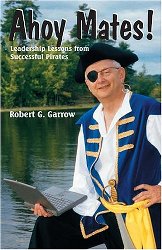
Ahoy Mates: Leadership Lessons from Successful Pirates
by Robert G. Garrow
Book Coach Press, 2003, ISBN 0-9680347-3-X, US $13.95
/ CAN $18.95
Ed
Mast, President of Applied Technology
Incorporated, has a problem. Some of his divisions
are profitable and others aren’t. Something needs
to change, but Ed isn’t sure how to go about
making those changes. While he waits for his top
executives to arrive for a board meeting, he looks
through an old logbook, which he recently received
from his dearly departed uncle Charlie. The log
belongs to an ancestor named Captain Bob, a
successful pirate. As Ed listens to his people
talk about sales, he wonders how Captain Bob will
handle the situation -- and the pirate instantly
appears!
This book is for managers who want to implement
change through innovation and employee
participation. Garrow, who conducts workshops in
management and leadership development and
strategic thinking and planning, utilizes the
world of pirates to explore three classic
management themes: mission and strategy; quality,
excellence, and productivity; and creativity and
innovation. The twist that separates his book from
all the others is a time-traveling pirate who uses
his knowledge of what makes a successful pirate
operation to help a company become more profitable
and productive.
While I read this book, I couldn’t help but think
how much more interesting all those staff meetings
I endured would have been. I definitely would have
paid more attention, and perhaps my employers
wouldn’t have had to rehash the same topics year
after year. My husband, who reads books like this
all the time, enjoyed Ahoy Mates! He
particularly liked the highlighting of tasks in
boxes and the chapter summaries, or anchor points,
which were concise and to the point. A good
selection of references on creativity are included
in an appendix, but my husband would have liked
more references on leadership. Something I
particularly liked was the presentation of pirate
tactics to insure a successful attack!
Review Copyright ©2004 Cindy Vallar
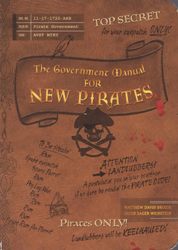
The Government Manual for New
Pirates
by Matthew David Brozik and Jacob
Sager Weinstein
Andrews McMeel, 2007, ISBN
978-0-7407-6790-6, US $10.95
When you first pick
up this book, you may ask
yourself why the government
would publish a how-to book for
pirates? After all, pirates
detest government – it goes
against most of what they
believe. It isn’t long before
the scurvy dogs who penned this
book explain that while “[t]he
radish-eatin’ land Government
don’t dare publish no manual for
us, no, but the Pirate
Government got no such qualms.”
Of course, you’re off to a bad
start in learning how to be a
pirate if you buy this book –
true pirates only acquire
treasure through stealing.*
Slightly larger than a pocket
guidebook, this manual is
divided into eight chapters of
information every
pirate-in-training needs to
learn. Chapter 1 helps you
locate pirates, including ways
to avoid the land and where to
find the best hot spots in
Tortuga, Hispaniola, and other
Caribbean islands. Chapter 2
addresses appropriate attire
from heads to pegs, as well as
accessories and what not to
wear. Chapter 3 provides
instruction on how to talk like
a pirate, while the next one
discusses pirate ships, covering
such information as good and bad
names, parts of the vessel, and
dangers that lurk in the oceans’
depths. Chapters 5 and 6 recount
the guidelines pirates should
abide by and how to fight in
true piratical style. The final
two chapters explain how pirates
amuse themselves and how they
locate buried treasure. There
are also four appendices –
lyrics to popular pirate
chanteys, a nontraditional
chantey attributed to Po’beard,
a favorite pirate recipe, and an
eye patch. The book is indexed.
If you’ve not guessed by now,
this manual is a tongue-in-cheek
look at the world of pirates.
Many sections will have you
smiling or laughing. A few may
make you groan. There’s a fair
amount of truth interwoven into
the text, but the information
about tricorne and bicorne hats
is backward. (Golden age pirates
wear the former, while Napoleon
and Admiral Nelson sport the
latter.) There are a few
sections where it’s wise to stay
alert, especially if the text
starts to bore you, for that’s
when you may discover a hidden
message. My two favorite
sections are “Speak in the
Manner of a Pirate,” which
includes “A Very Complex and
Intimidating Statistical
Equation,” and Appendix A, which
has a new version of “99 Bottles
of Beer on the Wall.” (If you
think the old one is
mind-numbing, wait until you
sing this one!) Even the book’s
cover contains important
information for readers. Great
for learning a bit more about
true pirattitude – as long as
you don’t take the advice too
seriously.
*Disclaimer:
As an author, I recommend
purchasing this book or
borrowing it from your library
rather than pilfering it. This
paragraph merely recounts what
the authors of the book wrote.
Review Copyright
©2004 Cindy
Vallar
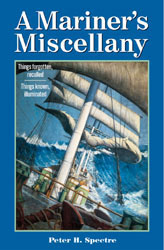
A Mariner’s Miscellany
by Peter H. Spectre
Sheridan House, 2005, ISBN
1-57409-195-6, US $19.95 / £12.95
This
compendium is a collection of
folklore, writings, poems,
drawings, and advice for
mariners and those with a love
of the sea. As the author
explains, it is “a combination
of the tangible and the
intangible – practical
information about boats,
anchors, rope, and ballast,
cheek by jowl with poetry,
legend, lore, superstitions,
language of the sea, art,
thoughts about literature, and
more.” The “more” includes life
at sea, sea songs, salty advice,
sailors’ food and drink,
navigation, communication, the
weather, the captain, the naming
of vessels, and historical
events and ships.
Although pirates are absent from
this book, it’s a wonderful
collection of information that
will educate and remind readers
of many aspects of the sailing
world both past and present. If
you enjoy Mr. Spectre’s annual
desk diary The Mariner’s
Book of Days, you’ll enjoy
this book even more.
Review
Copyright ©2006
Cindy Vallar
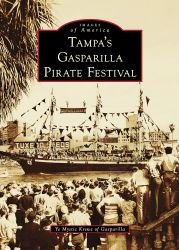
Tampa’s Gasparilla Pirate
Festival
by Ye Mystic Krewe of
Gasparilla
Arcadia Publishing, 2026,
ISBN 978-1467162975, US
$24.99
Travel
back to the early 1800s
and the Gulf of Mexico
on the western side of
Florida. A pirate and
his crew hunt in these
waters, but he is no
ordinary marauder. This
Spanish aristocrat
serves in the navy until
disillusionment drives
him and his men to
mutiny and go on the
account. His name? José
Gaspar, although his
pirate moniker may be
more familiar –
Gasparilla. In December
1821, Gaspar finally
meets his match, but
swinging from the
hangman’s noose holds
zero appeal. Instead, he
wraps himself in a heavy
chain and jumps
overboard.
An
intriguing history, yes?
Except it is fiction.
That doesn’t stop people
from being interested in
this pirate and over the
years his legend has
grown. Fast forward to
1880, when the town of
Tampa is a small blip on
the radar and only 720
people call it home.
Henry B. Plant sees
potential here,
especially for his
railroads and
steamships, so he builds
a hotel. Now he and the
townspeople need to
bring more and more
visitors to the
burgeoning city. The May
Festival will soon be
held. That’s when George
Hardee suggests a novel
idea: give the parade a
more exotic theme based
on the legendary pirate.
It works and for over
100 years, pirates have
invaded Tampa.
If
you think this a small
affair, think again.
What begins as fifty men
wearing pirate attire
and makeup in 1904, has
blossomed into a
thriving gala that
includes over 2,000
participants in 2025,
one of the largest boat
parades in the country,
a children’s parade,
intricate floats, and
sixty-five pirate
krewes. Who better to
tell this fascinating
history than the
founding group who still
participates in the
parade? Ye Mystic Krewe
of Gasparilla come from
all walks of life to
promote and serve their
community. They just do
so as scurvy cutthroats.
Part
of Arcadia’s Images
of America series,
this book tells the
story of the parade
through nine chapters of
black-&-white
pictures that show how
this festival has
changed and grown over
the years. Captions
provide intriguing
details about the parade
or artifact shown. A
slight drawback is the
frequent repetition of
some information, but
most readers will
overlook this.
This
journey into the past
demonstrates how an idea
based on history melds
into pop cultural events
that provide people with
a sense of community and
fun for the whole
family. Proceeds for
this book support the
non-profit Ye Mystic
Krewe of Gasparilla
Community Fund
Corporation, which
provides scholarships
for higher learning.
Review
Copyright
©2026
Cindy Vallar
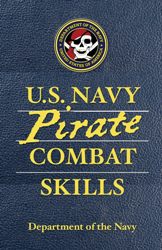
U.S. Navy Pirate Combat
Skills
by Department of the Navy
Lyons Press, 2011, ISBN
978-0-7627-7037-3, US
$14.95 / CAN $16.95
To
the uninitiated this
book may seem like a
manual on how to take
down pirates, but it
soon becomes apparent
that it is more
tongue-in-cheek than
reality. The guest
foreword, written by
“(Retired) Admiral I. I.
Scuttle, Commander of
the Fighting 44th
Anti-Pirate Assault, the
Most Decorated
Anti-Piracy Unit in U.S.
Navy History,” is a
rousing rah-rah
introduction to the
manual. There is nothing
subtle or toned down in
his narrative, and he
concludes his remarks
with an invitation to
join him in singing
"Pirate Slayers We," the
“age-old pirate-hunter’s
anthem.”
Arranged into two parts
– Offensive Strategies
and Defensive Strategies
– the information is
divided into sixteen
chapters.
- Pirate
Ship Boarding
Assaults
- On-Deck
Hand-to-Hand and
Hand-to-Hook Combat
- Handheld
Weapons
- Riverine
Assault Operations
- Waterway
Interdiction,
Surveillance,
Barrier, and
Security Operations
- Special
Operations
- Diving
in Support of
Anti-Pirate
Operations
- Parachute
Operations
- Miscellaneous
Anti-Pirate
Operations
- Weapons
- Demolitions
- Contingency
Planning
- Defensive
Command and Control
- Medical
Evacuations
(MEDEVACS)
- Survival
at Sea
- Escape
from Captivity
The
book also includes three
appendices: Nautical
Abbreviations, Seabag
Checklist, and Loadout
Lists. A host of
drawings illustrate key
points in the text, and
these often include
subtle humor (though if
the advice isn’t heeded,
the seaman or soldier
may well find himself in
dire straits).
U.S. Navy Pirate
Combat Skills is
an odd mixture of
18th-century scurvy dogs
and present-day hunters.
This field manual has a
ring of truth that makes
the reader think “if
only” we’d known that
then or had that
technology existed and
why can’t pirates today
be so easily defeated?
Review
Copyright
©2011
Cindy Vallar

Click to contact me
Background image compliments
of Anke's Graphics |
 Accounts Worth Reading
 Pirate Treasures