 Pirates and Privateers Pirates and Privateers
The History of Maritime
Piracy
Cindy Vallar, Editor
& Reviewer
P.O. Box 425,
Keller, TX 76244-0425

Books for Adults ~ History: Maritime
Cindy's
review
Merry Simmon's
review
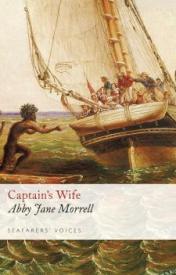
Captain’s Wife: Narrative
of a Voyage in the Schooner Antarctic 1829,
1830, 1831
by Abby Jane Morrell
Seaforth, 2012, ISBN 978-1-84382-125-0, US
$27.95 / UK £13.99

‘Hen
Frigates’ is a derisive name given to vessels
where the masters of merchant ships bring
along their wives during the 19th century.
Abby Morrell’s account is one of the first of
these narratives and concerns a three-year
voyage that takes her from New York to the
South Pacific. She marries Benjamin Morrell, a
cousin, in 1824 at the age of fifteen. Three
weeks later, Benjamin sets sail on a two-year
voyage. After other separations, including
another one lasting almost a year, Abby
decides that the next time he sets sail, she
will accompany him. “At first he apparently
would not hear of it; but ‘when I insisted (as
far as affectionate obedience could insist) he
at last reluctantly yielded . . . .” (5)
Soon after they embark in September 1829
aboard the Antarctic, Abby frets about
her young son, who remains on shore, and
suffers from seasickness. Eventually, she
overcomes both of these impediments and, with
little to occupy her days, becomes an observer
of life at sea, the various worlds she visits,
and the people she meets. In addition to her
many observations, she also argues for the
improvement of seamen, both in their working
conditions and as regards their education.
Whether she’s discussing cannibals, an
interfering American consul, or an earthquake,
she is matter-of-fact in her narrative. She
neither sensationalizes nor exaggerates,
unlike her husband who also leaves an account
of the voyage. A map depicting the various
islands visited appears in the front of the
book, making it easy for readers to locate
where Abby is at any stage in her journey
until her return home three years later.
Captain’s Wife is the seventh volume
in the Seafarers ' Voices series and is the
only one from a woman’s perspective. This
account, taken from the one published in 1833,
is considerably shorter, mainly because the
editor, Vincent McInerney, omits much of the
text that pertains to “religious and
evangelical matters of perhaps limited
interest to the majority of contemporary
readership, plus some topographical and
geographical material.” This book is highly
entertaining and readable, and more than once
readers will find themselves holding their
breath, sitting on the edges of their seats,
and marveling at Abby’s examination of life on
a ship and in exotic ports of call.
Review
Copyright ©2012 Cindy Vallar
Captain’s
Wife: Narrative of a Voyage in the
Schooner Antarctic 1829, 1830,
1831
by Abby Jane Morrell
Seaforth, 2012, ISBN 978-1-84382-125-0,
US $27.95 / UK £13.99
Captain’s Wife
is the seventh in a series
called Seafarers’ Voices that
offers firsthand accounts of
voyages covering a 200-year
period. This particular volume
is a newly edited version of a
journal detailing an 1829 to
1831 voyage from New England
to the South Pacific and back
by Abby Jane Morrell, a
merchant captain’s wife.
Originally published in 1833,
purportedly as “a plea for an
amelioration of the lot of
American seaman,” this
fascinating account more
importantly gives the reader a
clear vision of what such a
voyage is like from the unique
perspective of an educated
woman of the time.
Abby Morrell’s natural
curiosity and keen mind are
evident everywhere. She not
only carefully chronicles the
places her husband’s ship, the
schooner Antarctic,
visits, complete with vivid
descriptions of the flora,
fauna, and people encountered,
but she also offers insightful
comments on how these amazing
new things fit into the world
she knows. Her observations
may not always be
scientifically accurate or her
opinions considered
politically correct by
21st-century standards; she is
convinced of the superiority
of her own race and religion,
for instance, but this makes
her voice all the more true.
And for her time, her
attitudes are often
surprisingly liberal.
Of course, the most compelling
character encountered is Abby
Morrell herself. Married at
fifteen, she leaves one young
son with her mother to
undertake this voyage at the
age of twenty, giving birth to
a second son nine days after
returning home. Although she
makes no mention of her
indelicate condition in her
journal, it is easy to imagine
her waddling about the ship
hugely pregnant. I regret
Vincent McInerney’s
introduction doesn’t fill in
the rest of her life after the
voyage is completed. As it is,
someone the reader has come to
know and like just disappears
into the mists of time.
Abby’s husband, Benjamin
Morrell, also publishes an
account of this voyage in his
book entitled A Narrative
of Four Voyages. Abby
accompanied him on the fourth
and final one. I must admit I
sought out this book and
enjoyed reading the parallel
versions of this trip. The
facts are the same, but the
perceptions and areas of
interest are often very
different. In discussing her
efforts to convince her
husband that she should
accompany him, Abby only says,
“I insisted (as far as
affectionate obedience could
insist).” Benjamin’s
lengthier account details a
process that may be familiar
to some present-day husbands
by which she simply wears him
down.
By turns feisty,
opinionated, inquisitive, and
contemplative, Abby Morrell
lives and breathes on these
pages. Many will want to read
Captain’s Wife as a
tale of adventure, but what
has stayed in my mind is the
character of the incomparable
young woman who tells these
tales. Recommended.
Review
Copyright ©2012 Cindy Vallar

Click to contact me
Background image compliments
of Anke's Graphics |