Pirates and Privateers Pirates and Privateers
The History of Maritime
Piracy
Cindy Vallar, Editor
& Reviewer
P.O. Box 425,
Keller, TX 76244-0425

Servant,
Sailor, Soldier, Trooper, Taverner, Pirate
Mary Read
by Cindy Vallar
 Inspiration. Inspiration.
It doesn’t matter whether an author writes
fiction or non-fiction. Without some detail that
sparks an idea, the writing tends to sit on the
page and bore the reader. The author who sits to write A General History of the
Robberies and Murders of the Most Notorious
Pyrates in 1724, definitely needs
inspiration for one of his stories. He knows the
end of the tale; there are enough public
documents to inform readers. The beginning is
problematic, but omitting this pirate from the
book is not an option. Shocking, provocative,
and distressing – adjectives certain to lure in
the reader and garner sales. So, what to do
about the missing piece?
These thoughts must have circulated through
Captain Charles Johnson’s mind as he pondered
what to write about Mary Read. Clues about her
cohort’s origins and past existed, but Mary’s
origin story amounted to nearly zip. She was
born. She was female. She probably came from the
lower class. Not knowing more meant Johnson had
to fill in the blanks. He came across a possible
solution and began to write.
According to him, this extraordinary woman
defied conventions of the day not because that
was her initial intent, but because another
woman could not afford for her daughter to be a
female and survive. Prior to Mary’s birth, her
mother married a seaman who later vanished while
on a voyage.1
At the time, Mary’s mother was pregnant but not
with Mary. Mrs. Read gave birth to a son, likely
named Mark. Within that same year, she “met with
an Accident,” Johnson’s way of saying she was
expecting another child. (Johnson, 118)
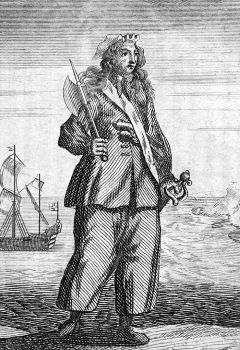 Scandal made tongues wag, and
with a husband far from home or deceased, giving
birth to another man’s child would bring shame
on Mrs. Read and her in-laws. To prevent this
and to retain the allowance the Reads provided
for her son’s upbringing, she and Mark went far
from London to visit with friends who would keep
her secret. Although her first-born died soon
after, Mrs. Read gave birth to a healthy
daughter whom she named “Mary.” The pair lived
together for three or four years on money Mrs.
Read had saved, but when her funds ran out, she
came up with a plan that required Mary to assume
her brother’s identity. Scandal made tongues wag, and
with a husband far from home or deceased, giving
birth to another man’s child would bring shame
on Mrs. Read and her in-laws. To prevent this
and to retain the allowance the Reads provided
for her son’s upbringing, she and Mark went far
from London to visit with friends who would keep
her secret. Although her first-born died soon
after, Mrs. Read gave birth to a healthy
daughter whom she named “Mary.” The pair lived
together for three or four years on money Mrs.
Read had saved, but when her funds ran out, she
came up with a plan that required Mary to assume
her brother’s identity.
On returning to London, Mark was re-introduced
to his grandmother, who agreed to give her
daughter-in-law a crown (sixty pence) each week
for support. That worked out well for both
mother and “son” until Grandma died.
At some point, Mary was let in on the secret of
her gender, but Mom convinced her that
maintaining the ruse was the better way to go.
Without the influx of cash from Grandma,
thirteen-year-old Mary had to find a job. A
French woman hired Mark to be her footboy. The
job didn’t last long, mostly because Mark craved
adventure, and the two parted ways. Mark also
bade his mom farewell and joined the Royal Navy
during the Nine Years War
(1688-1697).
Sometime later, the navy released Mark – maybe
his ship sank or was decommissioned, or maybe he
jumped ship, Johnson didn’t say – and since
England was fighting in Flanders (Belgium), Mark
enlisted in the Royal Army “in a Regiment of
Foot, as a Cadet” during the War of the Spanish Succession.
(Johnson, 119) Mark proved to be brave and
courageous at soldiering, but there was little
chance of advancement because he lacked the
means to pay for an officer’s commission (a
common practice during this time). His only
option was to resign and re-enlist in a cavalry
regiment.
Mark’s deeds on the field of battle brought high
praise from his officers, but he only cared what
one fellow thought. The handsome man who shared
their tent was from Flanders and Mark fell hard
for him. So much so that if he was sent out on
patrol, Mark volunteered to go along and put
himself in grave danger more than once, just to
protect the man. The others in their squad
thought Mark a bit mad, but otherwise never
questioned why he acted thusly.
Knowing his bunkmate might get the wrong idea
and take offense, Mark contrived a plan that
permitted him to discover the secret. He was
delighted and wanted Mary to become his
mistress. Perhaps because of the consequences
experienced by her mother, Mary did not believe
in sex before marriage. As a result, the man
courted her in secret until the campaign they
were on ended, and then arrangements were made
for a wedding.
The Story of two
Troopers marrying each other, made a great
Noise, so that several Officers were drawn
by Curiosity to assist at the Ceremony, and
they agreed among themselves, that every one
of them should make a small Present to the
Bride, towards House-keeping, in
consideration of her having been their
fellow Soldier. (Johnson, 120)
Thereafter, Mary and her husband
resigned their commissions and began operating
an ordinary (tavern) in Breda in the Dutch
Republic (Netherlands). The majority of those
who came to dine and drink at “the Sign of the
Three Horse-Shoes” were fellow soldiers and
cavalrymen. (Johnson, 121) Two events eventually
brought significant change to Mary’s happy life.
First, her beloved husband died. Second, the
warring countries signed the Peace of Reswick and the
soldiers went home. No longer bringing in
sufficient funds to run the ordinary, Mary
dressed as a man again and enlisted with the
Dutch army. She hoped to advance through the
ranks, but that wasn’t likely in times of peace,
so she resigned and signed aboard a ship sailing
to the West Indies.
That is Johnson’s version of Mary Read’s
backstory. He provides no indication as to his
sources for all this information. He merely says
that some readers “may be tempted to think the
whole Story no better than a Novel or Romance”;
in truth, this statement only refers to what
occurs after Mary becomes a pirate because there
are witnesses to those events. (Johnson, 117)
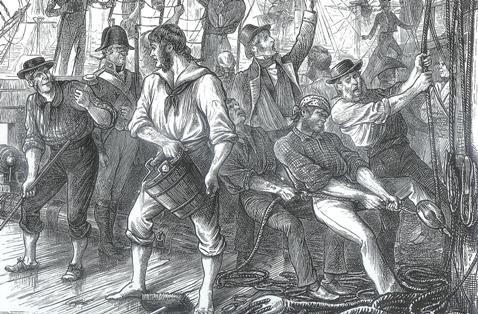 The
conundrum Johnson faced was how to make readers
believe that a woman could be a pirate –
a criminal, who pillaged at sea and wielded a
cutlass with the same adeptness as hauling on
ropes or doing any of the other tasks necessary
to sail a wooden ship. On top of this, readers
needed to empathize with her as a person.
(Whether heroine or villain, readers must relate
to the character or they don’t care what happens
to her.)2
Aside from coming up with why Mary Read was so
adept at being Mark Read, he needed to answer
why she continued to do so even after she no
longer needed to do so. The
conundrum Johnson faced was how to make readers
believe that a woman could be a pirate –
a criminal, who pillaged at sea and wielded a
cutlass with the same adeptness as hauling on
ropes or doing any of the other tasks necessary
to sail a wooden ship. On top of this, readers
needed to empathize with her as a person.
(Whether heroine or villain, readers must relate
to the character or they don’t care what happens
to her.)2
Aside from coming up with why Mary Read was so
adept at being Mark Read, he needed to answer
why she continued to do so even after she no
longer needed to do so.
Occupations open to women were few in the final
years of the seventeenth century. Men had rights
and could pursue a number of trades to earn a
living. Not so women. If she wanted freedom and
choice, instead of having to prostitute herself
to survive, Mary had to change who she was.
Doing so was not as farfetched as one might
imagine. Ballads of female warriors had been
popular since the Renaissance. They usually
involved women who dressed as men and went to
war, often preferring not to be parted from
their sweethearts. Their popularity increased
around 1650, once the printing press brought
broadsides and chapbooks to the masses for as
little as a halfpenny. Those who could read
shared the tales with those who could not, and
these people recounted what they heard through
word of mouth. Two examples of this street
literature that Johnson might have come across
were “The Mariners Misfortune”
and “The Gallant She-Souldier.”
Dianne Dugaw, who studied these songs, found
that the portrayals hit close to the mark when
comparing the songs to what lower-class women
experienced on a daily basis in the seventeenth
and eighteenth centuries. They acquired
“physical strength, toughness, independence,
fearlessness, and a capability of surviving by
one’s wits.” (Rediker, 114) Such women also had
to be convincing in this disguise in order to be
accepted as fellow male soldiers or seaman. For
Mary, this meant she had to curse and swear. She
became skilled in the usage of whatever weaponry
and instruments were required of the job, and
she had to demonstrate courage under fire.
 If not the street literature of
the day, perhaps the story of Christian Davies
inspired Johnson. Although her autobiography
wasn’t published until sixteen years after A
General History of the Pyrates, this
female warrior was known publicly at the time.
Kit Cavanaugh was born in 1667 in Ireland. She
spent most of her formative years living with
her aunt, who ran a Dublin inn. When the aunt
died, Kit became the owner and, at some point,
fell in love with Richard Welsh, who worked
there as a waiter. The pair wed and had three
children, but in 1692, Richard went on an errand
and never returned. Since he had been carrying a
large sum of money, Kit assumed that he had been
set upon and his body disposed of. Only later
did she learn that he had been pressed into the
army. This was intolerable as far as Kit was
concerned. He needed to be with her at home, and
she saw only one way to accomplish this. “I cut
off my Hair, and dressed in a Sute of my
Husband’s, having had the Precaution to quilt
the Waistcoat, to preserve my Breasts from hurt,
which were not large enough to betray my Sex,
and putting on the Wig and Hat I had prepared, I
went out and bought me a Silver hilted Sword and
some Holland Shirts.” (The Life, 20) As
Christian Welch, Kit joined the army and fought
in Flanders as she searched for Richard.
Although slightly wounded and captured by the
French at the Battle of Landen in 1693,
Christian’s secret remained intact. Once he was
exchanged, he returned to his regiment. If not the street literature of
the day, perhaps the story of Christian Davies
inspired Johnson. Although her autobiography
wasn’t published until sixteen years after A
General History of the Pyrates, this
female warrior was known publicly at the time.
Kit Cavanaugh was born in 1667 in Ireland. She
spent most of her formative years living with
her aunt, who ran a Dublin inn. When the aunt
died, Kit became the owner and, at some point,
fell in love with Richard Welsh, who worked
there as a waiter. The pair wed and had three
children, but in 1692, Richard went on an errand
and never returned. Since he had been carrying a
large sum of money, Kit assumed that he had been
set upon and his body disposed of. Only later
did she learn that he had been pressed into the
army. This was intolerable as far as Kit was
concerned. He needed to be with her at home, and
she saw only one way to accomplish this. “I cut
off my Hair, and dressed in a Sute of my
Husband’s, having had the Precaution to quilt
the Waistcoat, to preserve my Breasts from hurt,
which were not large enough to betray my Sex,
and putting on the Wig and Hat I had prepared, I
went out and bought me a Silver hilted Sword and
some Holland Shirts.” (The Life, 20) As
Christian Welch, Kit joined the army and fought
in Flanders as she searched for Richard.
Although slightly wounded and captured by the
French at the Battle of Landen in 1693,
Christian’s secret remained intact. Once he was
exchanged, he returned to his regiment.
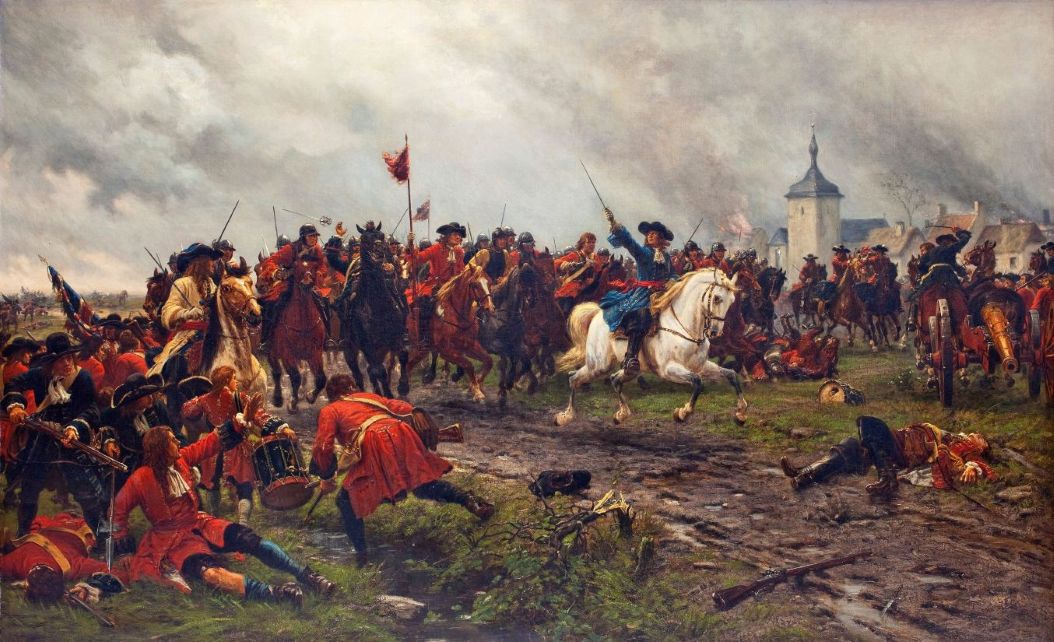
William III at the Battle
of Landen in 1693 by Ernst Crofts
(Source: Wikimedia Commons)
To reinforce his disguise among his
fellow company of foot, Christian wooed
a burgher’s daughter. This proved such a
successful venture that he ended up
fighting a duel over the woman. Having
wounded the sergeant, Christian was
brought up on charges. After the burgher
intervened, Christian was exonerated but
discharged from the army. The affair
caused the burgher to rethink
Christian’s suitability as a husband for
his daughter.
Kit still hadn’t located her
husband. Nor did she want to return home.
Therefore, Christian reenlisted, this time
with Lord John Hayes’s
Regiment of Dragoons.
While in Winter quarters in
1695, “[a] Lady of civil Conversation” took a
liking to him, but Christian failed to pay
adequate attention to her. Vexed at being
repulsed, the lady wanted payback. She swore
that Christian was her child’s father.
Surprised and angered, Christian initially
considered charging her with perjury. Instead,
he agreed to pay the woman child support. The
babe died a month later, but “left me the
Reputation of being a Father,” which merely
added to the success of Kit’s disguise. (The
Life, 37)
Peace came a short time
later, and Kit returned to Dublin. Since her
children and mother were doing fine, she opted
to remain in disguise because “I was so much
altered by my Dress, and the Fatigues I had
undergone, that not one of them knew me, which
I was not sorry for.” (The Life, 40) In
her male persona, Christian found a job, until
war broke out anew and he rejoined his dragoon
regiment.
Even though he suffered a
second wound at the battle of Schellenberg
in 1704 during the War of the Spanish
Succession, no one discovered his secret.
Later that year, he participated in the battle at Blenheim
(Germany). All this time, Kit’s inquiries as
to her husband’s whereabouts proved fruitless.
It wasn’t until Christian was detached to
escort French soldiers to their imprisonment
that he happened upon a couple embracing in
the street. The man looked familiar, so
Christian took a closer look. It was
my perfidious Husband, on
whose Account I had experienced so much
Fatigue, such Misery, and had so often
hazarded my Life. The seeing him
caress the Dutch Woman . . . raised in me
so great an Indignation,
that I was resolved to banish every tender
Thought which might plead in his Favour,
and wipe the Idea of him out of my Memory.
(The Life, 59)
Second thoughts brought a
realization that perhaps they were both at
fault. Rather than reveal that she had found
her husband, she told concerned comrades that
she had finally located her brother after
twelve years.
Their reunion was not what
Kit dreamed of, and she banished Richard from
her bed for his betrayal. When she later found
him with the Dutch woman again, Kit “cut her
Nose off close to the Face, except a small
Part of the Skin, by which it hung.” (The
Life, 84) Finally seeing the error of
his ways, Richard agreed to continue the ruse
that he and Christian were brothers and hoped
that one day they would one day live as
husband and wife again.

Queen's Regiment of Horse
at battle of Ramillies by unknown artist
(Source: Wikimedia Commons)
This charade didn’t change
until the battle at Ramillies in
1706. Christian suffered a wound to his head,
that required him to be
trepaned, and great Care
taken of me, but I did not recover in less
than Ten Weeks: Though I suffered great
Torture by this Wound, yet the Discovery
it caused of my Sex, in the fixing of my
Dressing, by which the Surgeons saw my
Breasts . . . was a greater Grief to me.
No sooner had they made this Discovery,
but they acquainted Brigadier Preston,
that his pretty Dragoon (so I was
always called) was, in Fact, a Woman.
He was very loath to believe it, and did
me the Honour to say, He had always
looked upon me as the prettyest Fellow, and
the best Man he had. (The Life,
75)
Richard confessed that they were
husband and wife, and once Kit recovered, they
renewed their marriage vows in the presence of
their officers, some of whom gave them pieces
of gold as a wedding present. Although she was
dismissed from service, she remained with the
company first as a regimental cook and then as
a sutler. As such, she foraged for food and
water, went between lines, and carried
messages.
Richard was killed in action
three years later, and Kit searched for his
body for a day. Although distraught, Kit
remained with the army and eventually wed a
grenadier named Hugh Jones. He was wounded
during a siege in 1710, and died about two
months later.
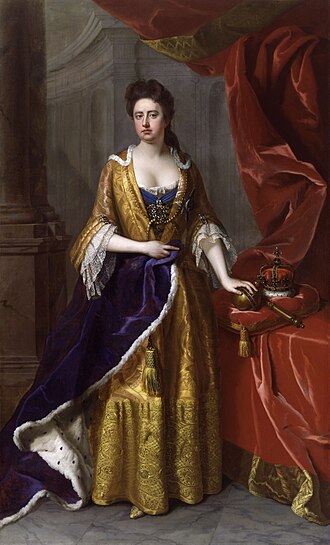 In 1712, Kit
decided she had sacrificed enough, retired,
and went to England, where she met and
petitioned Queen Anne for a
pension. The monarch granted Kit one shilling
a day for the rest of her life. She returned
to Ireland, where she opened an establishment
that sold beer and pies. When she passed away
at Pensioner’s College in Chelsea (England) in
1739, she was buried with full military
honors. Three volleys were fired in salute. In 1712, Kit
decided she had sacrificed enough, retired,
and went to England, where she met and
petitioned Queen Anne for a
pension. The monarch granted Kit one shilling
a day for the rest of her life. She returned
to Ireland, where she opened an establishment
that sold beer and pies. When she passed away
at Pensioner’s College in Chelsea (England) in
1739, she was buried with full military
honors. Three volleys were fired in salute.
Did you notice similarities between Mary’s
backstory and Christian’s tale? For one thing,
the two ladies were of a similar age and
fought in the Nine Years War.3
For another, they were both skilled in
masquerading as men. It wasn’t enough to wear
men’s clothing: their actions needed to mirror
those of the male persuasion, including
fighting, carousing, swearing, and walking. In
James L. Nelson’s The Only Life That
Mattered, which tells the story of Mary
Read and Anne Bonny, he depicted a scene
during this war.
She rode through the pre-dawn black, the
horse and saddle between her legs as easy
a fit as a well-worn hat. The smell of the
horses, the cumulative sound of a hundred
or more riders moving together, was all so
familiar now that they did not intrude at
all on her thoughts.
She
reached down and adjusted her saber where
it was chaffing on her thigh, cleared her
throat, and spit on the dirt road below
her. (Nelson, 28)
For Christian, “she had lost that
Softness which heightens the Beauty of the
Fair, and contracted a masculine Air and
Behaviour.” (The Life, iii)
 Whereas Johnson
had to look elsewhere for inspiration on the
details of Mary’s life before she became a
pirate, historical accounts provided specifics
of what became of her after she came to the
Caribbean, possibly around 1718 or 1719. At
some point in the voyage, pirates captured the
merchant ship on which Mark Read crewed.
Although never named, these men might have
been under the leadership of Charles Vane. This was
most likely when Mark first met John Rackham, who was
Vane’s quartermaster at the time. Whether Mark
became a willing pirate or was forced even
Johnson couldn’t say. All he wrote was that
Mark was accepted into the company because he
spoke English, whereas all his Dutch comrades
and their ship were released once the pirates
finished their plundering. Whereas Johnson
had to look elsewhere for inspiration on the
details of Mary’s life before she became a
pirate, historical accounts provided specifics
of what became of her after she came to the
Caribbean, possibly around 1718 or 1719. At
some point in the voyage, pirates captured the
merchant ship on which Mark Read crewed.
Although never named, these men might have
been under the leadership of Charles Vane. This was
most likely when Mark first met John Rackham, who was
Vane’s quartermaster at the time. Whether Mark
became a willing pirate or was forced even
Johnson couldn’t say. All he wrote was that
Mark was accepted into the company because he
spoke English, whereas all his Dutch comrades
and their ship were released once the pirates
finished their plundering.
Eventually, Read, Rackham,
and others decided to take the king’s pardon.
What Mary (or Mark) did during this time was
unknown and where she did so was not recorded.
All Johnson said was that she “liv’d quietly
on Shore.” (Johnson, 121)
To be continued . . .
Notes:
1.
An interesting side note is that on 25
March 1698, Ann Canterell sent a letter
to Adam Baldridge. Once a pirate
himself, Baldridge relocated to
Madagascar where he built a trading
post, a house, storehouse, and log
fortress protected by six cannons on St.
Mary’s Island. His clientele were
pirates who exchanged gold and other
booty for the supplies they needed.
Ann wrote to Baldridge to claim her
husband’s effects and provided some
documentation to prove she was the
pirate’s wife. She lived in Bristol with
a son and a daughter named Mary, whose
christening at a local church showed
that Mary was born around the same time
as the pirate Mary Read. The earliest
details of these Marys’ lives align with
what Johnson shared, but whether they
are one and the same girls is unlikely
to be proven. Both young girls had
mothers who married seamen and their
fathers died when the girls were young,
just as Johnson claimed.
2.
For those who would like to understand
this more, check out this edition of
“The Red Pencil,” a column I wrote for Solander
in 2008. I focus on how John Shors
created a villainous protagonist in
Beside a Burning Sea.
3. Johnson’s
timeline for Mary’s life doesn’t work
well and neither he nor the trial
transcripts provide her age or birth
year. The general consensus is that she
is in her thirties when she arrives in
the West Indies. As Rebecca Simon
explains, Mary was probably “only twelve
years old at the end of the [Nine Years
War],” so it’s “most likely [she] fought
in the War of the Spanish Succession,
which began in 1703, at the age of
eighteen and concluded in 1713 when she
was twenty-eight years old.” (Simon, 61)
No historical documents list “Mark Read”
as having served in the army or cavalry,
“but this does not mean that she did not
fight under another unknown name.
However, since she would be such a
skilled and fierce pirate, it is
reasonable to believe that she had
sufficient military training to be able
to hold her own and succeed.” (Simon,
61)
Dr. Simon also mentions that The
Evening Post for 20 January 1719,
lists names of those who were sentenced
to “death at the Old Bailey for various
crimes.” (Simon, 61) One of these is
Mary Read, who declared that she was
pregnant at the time. Instead of being
executed, this Mary is transported to
the Caribbean to “work in the plantation
colonies.” (Simon, 62) If this Mary is
the same as the pirate, as an escaped
criminal, turning to piracy may have
been her only option.
For more information, I suggest the following:
“America and West Indies:
November 1720, 1-15,” in Calendar
of State Papers Colonial, America and West
Indies: Volume 32, 1720-1721 edited by
Cecil Headlam (London 1933), British
History Online. (Nov. 13. Jamaica,
288.) Accessed 9 March 2026.
“America and West Indies:
June 1721, 1-15,” in Calendar of
State Papers Colonial, America and West
Indies: Volume 32, 1720-1721 edited by
Cecil Headlam (London 1933), British
History Online. (June 12. Jamaica,
523.) Accessed 9 March 2026.
The American Weekly
Mercury. 31st January to 7th
February 1721. HathiTrust. Accessed
9 March 2026.
Appleby,
John C. Women and English Piracy
1540-1720: Partners and Victims of Crime.
Boydell, 2013.
Cartwright, Mark. “Mary Read,” World
History Encyclopedia. 5 October 2021.
Chevalier,
Noel. Charles Johnson’s General
History of the Pyrates and Global
Commerce. Bucknell University, 2025.
Cordingly,
David. Pirate Hunter of the Caribbean:
The Adventurous Life of Captain Woodes
Rogers. Random House, 2011.
Cordingly,
David. Women Sailors & Sailors’
Women: An Untold Maritime History.
Random House, 2001.
Dugaw, Dianne M. “Structural Analysis of the
Female Warrior Ballads: The Landscape of a
World Turned Upside Down,” Journal
of Folklore Research. 23 (1), April
1986, 23-42.
Dugaw,
Dianne. Warrior Women and Popular
Balladry, 1650-1850. University of
Chicago, 1989.
Eastman, Tamara J., and Constance
Bond. The Pirate Trial of Anne Bonny and
Mary Read. Fern Canyon, 2000.
Geoghegan, Patrick M. “Davies, Christian (alias
‘Mother’ Ross, Kit ‘Kitty’ Cavenaugh),”
Dictionary of Irish Biography
(October 2009).
Gibbs, Joseph. “The Brevity and
Severity of ‘Golden Age’ Piracy Trials,” International
Journal of Maritime History. 31 (4),
2019, 729-786.
Hanna, Mark H. Pirate Nests
and the Rise of the British Empire,
1570-1740. Omohundro Institute of
Early American History and
Culture/University of North Carolina, 2015.
Johnson, Charles. A General History of the
Robberies and Murders of the Most
Notorious Pyrates. Ch.
Rivington, 1724.
The Life and Adventures
of Mrs. Christian Davies, the British
Amazon, Commonly Called Mother Ross.
Second edition. R. Montagu, 1741.
Liu, Tzu-Yu. “She-Pirates: Early
Eighteenth-Century Fantasy and Reality,”
The 18th-Century Common, 11 June
2019.
“Mary Read – The Most
Underrated Female Pirate?” Gold
and Gunpowder. 10 November 2023.
“The Monstrous Regiment?
The Woman Who Fought in the British Army
Disguised as a Man,” Portals to
the Past. Accessed 9 March 2026.
“Mrs. Christian Davies,”
The 2nd Dragoons (Royal Scots Greys).
Accessed 9 March 2026.
Nelson, James L. The Only Life
That Mattered. McBooks, 2004.
O’Driscoll, Sally. “The Pirate’s
Breasts: Criminal Women and the Meanings of
the Body,” The Eighteenth Century.
53 (3), Fall 2012, 357-379.
Rediker, Marcus. Villains of
All Nations: Atlantic Pirates in the
Golden Age. Beacon, 2004.
Simon, Rebecca Alexandra. Pirate
Queens: The Lives of Anne Bonny & Mary
Read. Pen & Sword, 2025.
The Tryals of Captain
John Rackham, and Other Pirates.
Robert Baldwin, 1721.
Review
Copyright ©2026 by
Cindy Vallar

Click to contact me
Background image
compliments of Anke's Graphics
|