 Pirates and Privateers Pirates and Privateers
The History of Maritime
Piracy
Cindy Vallar, Editor
& Reviewer
P.O. Box 425,
Keller, TX 76244-0425

Books for
Adults ~ Biography: Navy Seamen & Merchant Sailors
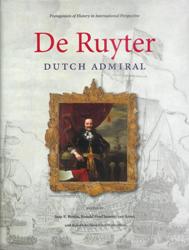
De Ruyter: Dutch Admiral
Edited by Jaap R. Bruijn, Ronald Prud’homme van Reine,
and Rolof van Hövell tot Westerflier
Karwansaray, 2011, ISBN 978-94-90258-03-0, US $92.22 /
euro €70

Far too
often books on historical persons focus on a limited
point of view, rather than presenting a global
perspective of them. Karwansaray seeks to correct
this with a new series of books “[w]ith the
intention of promoting the growth of a collective
European historical consciousness . . . where
historians from different countries describe figures
of international importance.” (7) For their
inaugural release, the publisher selected Michiel
Adriaenszoon de Ruyter, the Dutch admiral who was
respected and honored throughout Europe during his
lifetime.
De Ruyter is far from a typical biography,
yet it is an absorbing collection of essays that
provide a unique and intriguing perspective of this
gentleman. The writings reflect this as they examine
his life, both professional and personal, as seen
through the eyes of his countrymen, as well as the
allies and enemies of the Netherlands. This allows
the authors to provide glimpses into life and
politics during the 17th century, a time when the
Dutch played a major role in maritime history and
much of Europe was embroiled in various wars.
Bruijn’s introduction provides an excellent overview
of the man and his times, and sets the stage for the
chapters that follow.
The Maritime
World of the Dutch Republic by Jaap R. Bruijn
Well-written and
concise summary that includes sections on the
Dutch Republic, the VOC and the WIC, trade and
commerce, whaling, privateering, and the navy.
Michiel Adriaenszoon de
Ruyter and his Biographer Gerard Brandt by Ronald
Purd’homme van Reine
Fascinating assessment
of De Ruyter’s life and Gerard Brandt’s biography
of the admiral written in 1685, a book that
immortalized him and became a bestseller. It also
includes an interesting explanation of how
biographies were written at the time. Two
encounters with Dunkirk privateers appear as well.
Merchants, Diplomats,
and Corsairs: The Dutch in Barbary in De Ruyter’s
Time by Karim Bejjit
Objective inspection
that illuminates the complexity of affairs
pertaining to the Barbary States, especially as
concerns Dutch relations with them from 1600-1644,
and de Ruyter’s experiences dealing with Morocco,
Algiers, and Tunis.
The Dutch Republic as a
Great Power: Political Interaction and Armed
Forces by Jan Glete
Comparative look at the
Dutch army and navy with that of other countries.
Navies, Strategy, and
Tactics in the Age of De Ruyter by John B.
Hattendorf
Also a comparative
study, this focuses on naval development in
England and the Netherlands, as well as the three
naval conflicts fought between these two nations
from 1652 to 1674.
The Good Enemy: British
Perceptions of Michiel de Ruyter and the
Anglo-Dutch Wars by J. D. Davies
Entertaining and
informative essay that examines the admiral from
the perspective of a plain seaman and a mythic
hero. Includes a comparison between de Ruyter and
his English contemporaries.
Danish Perspectives on
de Ruyter’s Role in the Nordic Conflicts by Niels
M. Probst
Interesting chapter on
Denmark’s war against Sweden, but the major focus
seems to be Niels Juel, rather than de Ruyter, a
man with whom Juel sailed more than once.
Michiel de Ruyter’s
Expedition to West Africa and America, 1664-1665
by Henk den Heijer
Captivating account of
a mission carried out in secret that would lead to
the Second Anglo-Dutch War and the role de Ruyter
played in it. Also briefly touches on his dealings
with the Barbary corsairs.
De Ruyter versus
Duquesne: A Battle to the Death by Michel
Vergé-Franceschi
Detailed survey of a
war that pitted two worthy adversaries against
each other with particular emphasis on the French
perspective of the battle in which de Ruyter dies.
De Ruyter and his flag
officers by Jaap R. Bruijn
Analysis of the two
manners – before and after a standing navy became
standard – in which flag officers were selected
during de Ruyter’s career, the men who held these
positions, and what is known of his relationships
with them.
De Ruyter in Paint by
Ronald Prud’homme van Reine
Intriguing examination
of de Ruyter from an unusual perspective that
provides insight into his personal life.
Several maps precede the
essays, which are handsomely illustrated with
reproductions of artwork, photographs, period maps
and charts, and artifacts – many of them in color –
connected to de Ruyter, whose signature appears at
the bottom of each page in gold. Each chapter opens
with a double-page spread of a painting that
pertains to the subject matter within. Although the
font size is small, the abundance of white space on
each page makes it easy to read. The book concludes
with a Select Bibliography, References for the
various chapters, an Index of ship names, an Index
of geographical names, and an Index of persons. The
final three pages include short biographies of the
contributors that clearly show why each is eminently
qualified to write on the subject.
The invaluable content and handsome presentation
make this a valuable addition to any library
interested in maritime history, European history,
and naval history. It is an insightful examination
of a man whom Louis XIV identified as “a man who did
honour to humanity.”
Review
Copyright ©2012 Cindy Vallar

Click to contact me
Background image compliments
of Anke's Graphics |